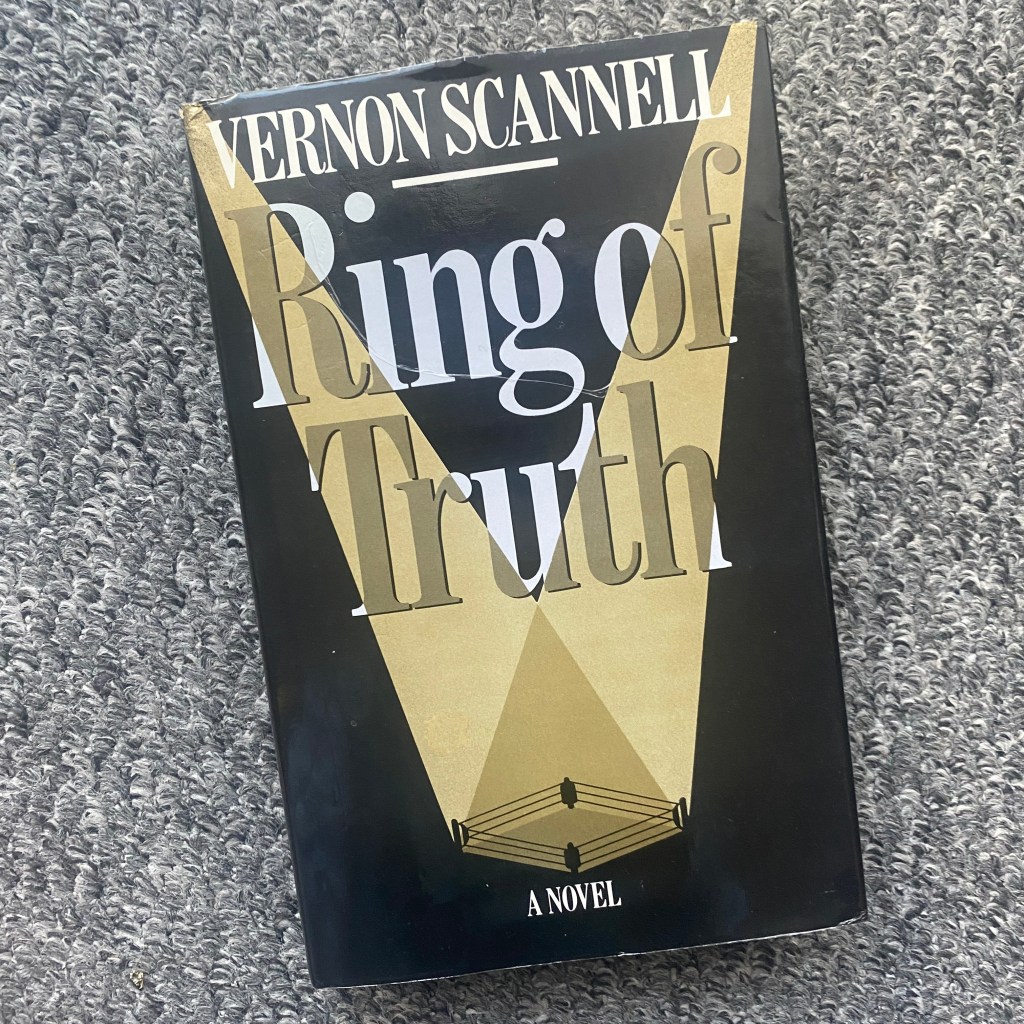
I’ve been meaning to get around to reading something by Vernon Scannell for a few years, as he’s referenced a lot in contemporary non-fiction books about art and writing related to boxing. Scannell published a number of novels and poetry collections in his lifetime, many of these books referencing or focusing on boxing. One of the reasons Scannell is mentioned so often is because he boxed (perhaps unsurprisingly for someone born in Britain in 1922 and who served in the British army), so is held up as an example of a writer of boxing who really knew the sport. On the dust jacket of this book (and in various places online) Scannell is listed as having been a national schoolboy and senior boxing champion, but it seems unlikely that this was with the ABA’s as there is no record of these achievements in the England Boxing records under his birth name John Bain. To give him the benefit of the doubt, this could have all been a misunderstanding and the publisher could have been referring to other prizes and achievements. The dust jacket also suggests he boxed professionally in travelling booths, which seems much more likely as many men earned money from boxing in fair booths at that time. Anyway, his is an interesting life and career which some of you might want to check out.
Published in 1983, Ring of Truth is the story of a fictional boxer from Leeds, Dave Ruddock, the newly crowned middleweight champion of the world. We follow Dave’s career and family life as he prepares to defend his title against an unbeaten American, Earl Hayes – himself touted as the next Sugar Ray Robinson. As a side note, I’ve got my suspicions that the story might have drawn a bit from Dave Boy Green’s 1980 bout with Sugar Ray Leonard – an upright, predictable but very game British boxer given no chance against a seemingly unstoppable US phenom.
Through Ruddock’s friendship with ‘worldly’ and ‘clever’ childhood pal Tom Darwin we seem to be given an insight into two conflicting parts of Scannell’s own mind. There’s a clear and passionate love of the sport throughout, but the question of the ethics plays out through the baseless commitment to boxing from Tom, who, through disagreements with his reporter girlfriend Peggy, is constantly forced to reevaluate his support for what she sees as only brutality. This is definitely a novel by someone trying to come to terms with the impossibility of being able to reconcile these opposing positions in his own head.
An interesting through-line is Dave’s brother Martin going off to fight on the Falkland Islands, and getting injured in the process. There are some interesting questions raised by Scannell about how some forms of violence are viewed as valorous, with others seen only as barbaric. Throughout, Ruddock openly questions why he’s not more respected for his achievements, and not in the pursuit of fame, while the idea of noble young men going off to ‘defend’ their nation is being used as an excuse to send young men to their death. Scannell, through his protagonist, also asks whether a country living under the blight of Thatcherite policies might see an explosion of unemployed men returning to the ring, desperate to pay the bills. I haven’t yet thought of a way to check the reality of this but I’d be interested to know if it did have any effect.
There are sections in this novel in which Dave and Tom are trying to explain and/or justify the sport to the women in their lives, and from these you get a sense of just how informed Scannell was about boxing, but it unfortunately doesn’t make for very exciting prose. In trying to highlight just how ‘normal’ Dave – and therefore boxers in general – is, we’ve ended up with a novel which drags on a bit too much like real life. Along the way there’s an affair, an amicable divorce and a lot of other drama that brings little of interest.
This slow pace and heavy-handed approach to explaining ‘the game’ and its counterpart ‘the business’ is a shame, as the final two chapters deal with Haye’s bout, and its bleak and sad aftermath, with great attention to tension and suspense. The fight is described with good detail, and from an array of perspectives, with the tragedy that follows being treated with a grave solemness which, perhaps rightly, offers no real justification for anyone’s point of view – except possibly that of the mothers and wives left to deal with the grief of war and violence? It’s a shame that this clarity of prose wasn’t present in the 300 pages leading up to the Hayes fight.


Leave a Reply