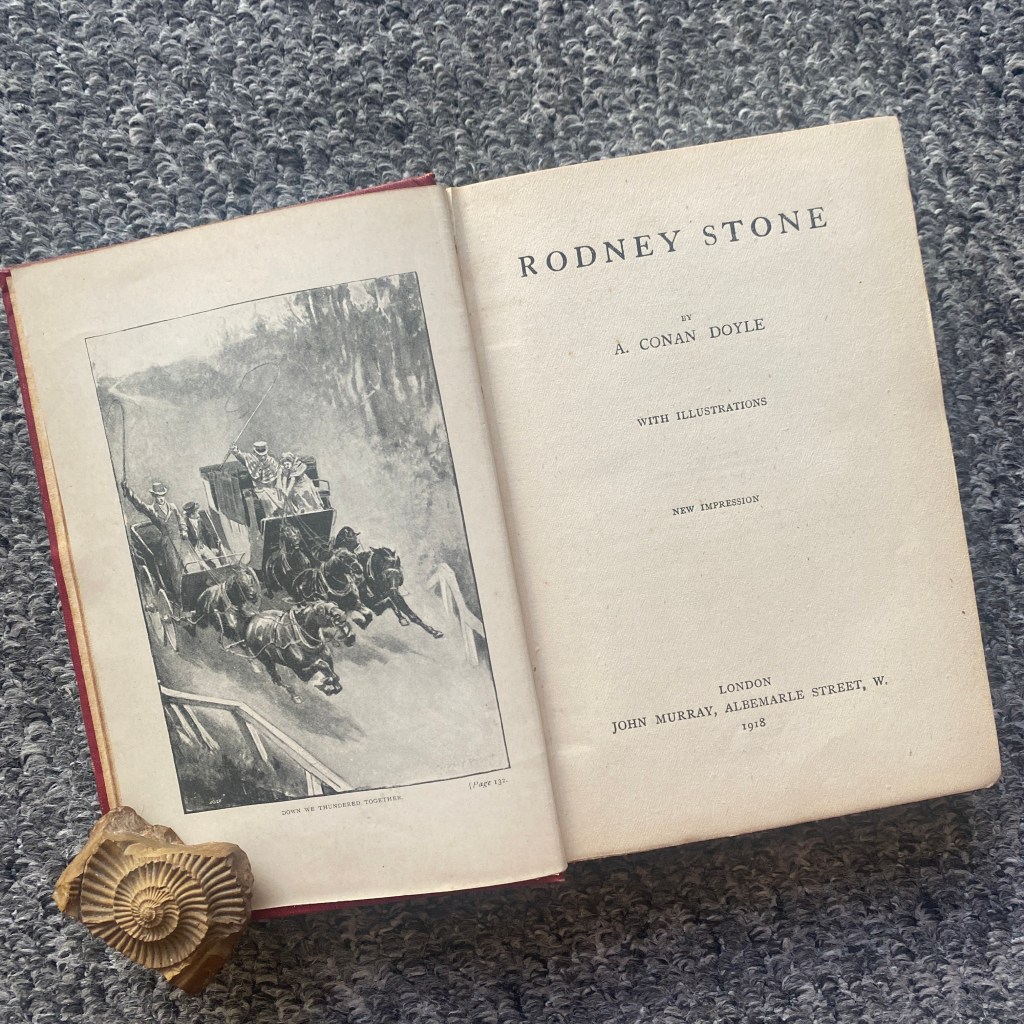
What an odd book! Amongst a lot of research about stagecoach driving and naval procedure there’s an interesting story about a fictional prizefight folded into Arthur Conan Doyle’s Rodney Stone. I think I need to declare early on that this novel represents and echoes aspects of late-Victorian/early-Edwardian literature which have always annoyed me. Most notably here, the idea that all a character needs to truly prove themselves to the world is to discover that they are the secret offspring of a member of the English nobility. Anyway, it seems necessary to acknowledge my bias in case the following feels too negative.
(Coincidentally, this book has inspired a new novel by Thomas Hauser, Sherlock Holmes and Mrs Rutledge. Out soon/now.)
This seems a bit of a crazy thing to say of such an accomplished author but Conan Doyle feels caught between a number of ideas throughout this novel. Rodney Stone rattles along (in parts) like a fairly standard crime/mystery novel, dropping constant clues and red herrings, and with a few nods toward potential occult connections which the author is never far from; but too often it becomes bogged down in the details of minor plot lines. For example, there is an extended scene (an entire chapter) set in a pub, frequented by sailors and naval officers, in London, which seems to me to have added almost nothing other than unnecessary pages to the book; except perhaps an attempt to highlight the honour and legacy of boxers contemporary to the setting of the book, when they are all together themselves in a different London pub (at a time when London’s pubs were heavily associated with specific trades).
When he writes about the boxers, Conan Doyle does so with a great deal of empathy, clarity and knowledge. The scene in the pub – while it does take on the air of an illustration of an imagined gathering of the greats, which might hang in a gym or themed bar – felt a lot like a real ex-boxers’ meeting in the 21st century, not least when they are bemoaning the disrespect shown by younger men (though with a lot more drinking and far worse tempers than now).
One of the highlights of the book is the author’s use of dialogue, and the very natural and appropriate use of Georgian-era fighting terminology. This includes, of course, classic terms like ‘milling’ for fighting, but also a few new to me, such as a member of the fancy complimenting the conditioning of two boxers by saying they buffed well. There is a general, unwavering admiration throughout for anyone brave enough to step into a prize ring, and I think it’s this open respect for working class men which makes the overarching theme of the book, and its obsession with measuring a person’s worth against their social standing, so jarring – and frustrating. Even when Rodney Stone himself rejects a place amongst the fops and dandies of London, he still does so by following his father in taking his (natural) place in the admiralty at the direct invitation of Horatio Nelson.
There are a lot of similarities between Conan Doyle’s descriptions of (largely illegal) prizefights and William Hazlitt’s essay The Fight. Because of the attention paid to the pugilists, and to the huge crowds of spectators, drawing in folk from every strata of society. There’s a connecting thread to be drawn here from Hazlitt to Conan Doyle, up through Liebling to McIlvanney, when it comes to recognising the importance of the fans to the fight game:
A succession of heaves from the back of the crowd had sent a series of long ripples running through it, all the heads swaying rhythmically in the one direction like a wheatfield in a squall. With every impulsion the oscillation increased, those in the front trying vainly to steady themselves against the rushes from behind, until suddenly there came a sharp snap, two white stakes with earth clinging to their points flew into the outer ring, and a spray of people dashed from the solid wave behind, were thrown against the line of beaters-out. Down came the long horse-whips, swayed by the most vigorous arms in England; but the wincing and shouting victims had no sooner scrambled back a few yards from the merciless cuts, before a fresh charge from the rear hurled them once more into the arms of the prizefighters. Many threw themselves down upon the turf and allowed successive waves to pass over them.
Anyway, I’m glad I read the book as there were some fantastic boxing scenes (descriptions of reddened ribs resulting from bareknuckle body shots). The novel very much reinforces Conan Doyle’s admiration for boxing, and shows how the formation of the Amateur Boxing Association in 1881, and the general Victorian drive to regulate, formalise and export boxing (and other sports) around its empire, clearly influenced his best known character Sherlock Holmes. The public image of the Britain of Rodney Stone, Arthur Conan Doyle and Sherlock Holmes was rooted in this idea of gentlemanly gallantry/violence, and was often framed as a rejection of underhanded foppish and continental reliances on anything other than a square go with the fists – all the while adhering to the rules, the rules, the rules! It’s under this lens that it makes more sense for the nobility take a bit of a bashing, and with the constant references to longstanding naval battles with Napolean in the Mediterranean. Perhaps Arthur just felt he needed more of an excuse to write a love letter to half-naked fellas belting the life out of each other in muddy fields on the Surrey/Sussex/Hampshire borders?
 Writers on Boxing
Leave a comment