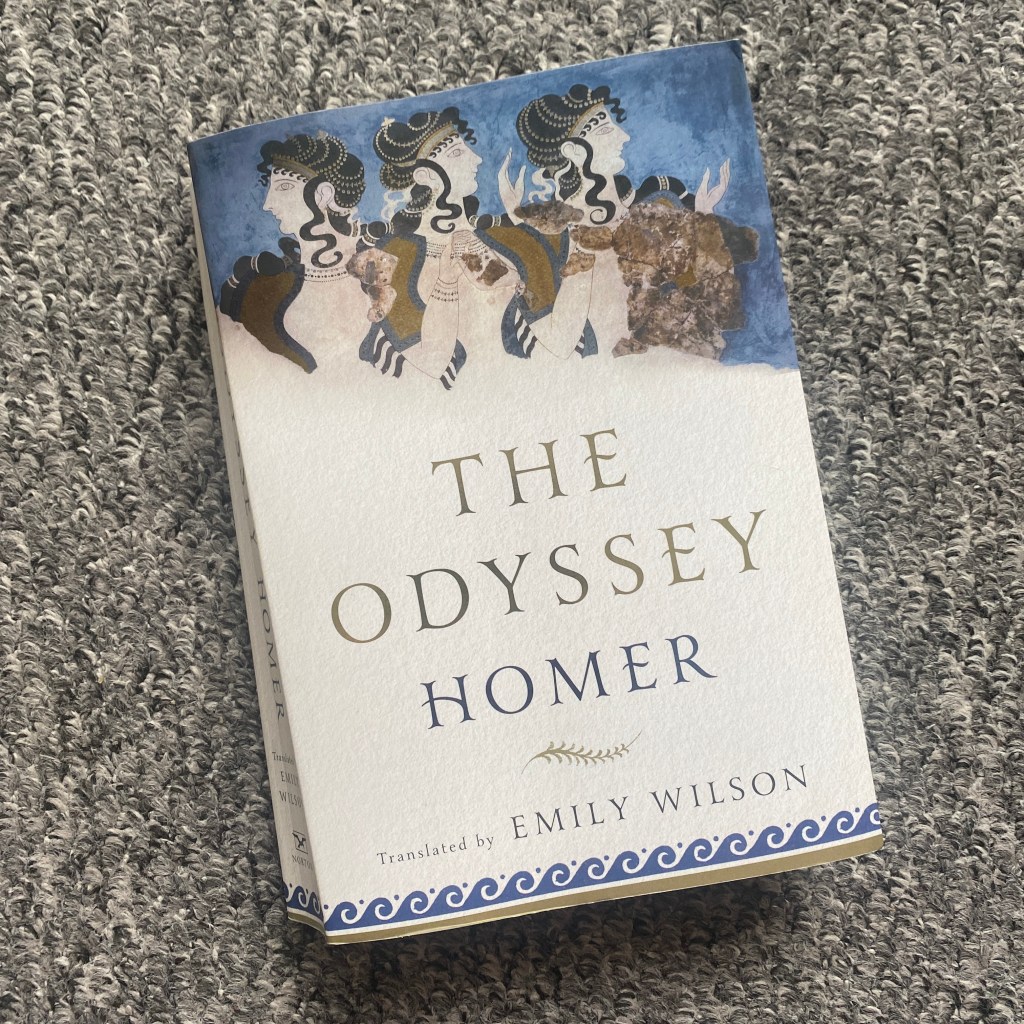
I’ve been meaning to read Emily Wilson‘s translation of The Odyssey for a few years now. (I’ve been trying to work this one out but this is at least the third translation I’ve read of The Odyssey, as well as possibly some abridged or age appropriate versions when I was a child.) I decided that I was going to buy it for myself as a treat for submitting my MA dissertation this summer – I had no idea that Christopher Nolan was about to release his blockbuster cinematic interpretation! I don’t know where it comes from but I’d usually avoid this sort of hullabaloo; but I put this to one side this time around, and picked up a new copy from a bookshop (due to the release of the film secondhand copies are scarce online).
Anyway, I really enjoyed Wilson’s translation, in which less grandiose language is used compared to the established versions, which have chosen to highlight and reflect the academic work needed for translation in the prose on the page – particularly the dialogue. I’m particularly pleased that Wilson has shown Odysseus’s decision-making as being problematic. Though I suppose there wouldn’t have been much of a story if Odysseus hadn’t let his ego get the better of him and shouted his name back to Polyphemus as his men were rowing away from his island. It’s just a shame that the lads get so much stick for killing and eating Helius’s cattle.
Soooooo… why am I mentioning this book here? In book 18 of The Odyssey, ‘The Two Beggars’, (I don’t remember if the section titles are the same in other translations), Odysseus returns to Ithaca and, disguised as a beggar, confronts a second beggar, Irus. After some very Homeric chat about honour and virtue the two are lined up to fight as entertainment for Penelope’s suitors:
These words increased his shakiness. Escorted to the ring, he stood. Both raised their fists. Odysseus, who had endured so many insults, wondered if he should hit him hard enough to kill him, or give him just a tap to knock him down. A light touch would be best, he thought, in case the suitors cottoned on. They came to blows. First Irus hit Odysseus’ shoulder; Odysseus punched Irus on his neck below the ear, and broke his jaw. Red blood gushed from his mouth, and with a moan he fell, teeth chattering, legs flailing.
This is a tiny example taken from an epic poem and I wondered whether it had any relevance here, but I don’t think I’d have read any books – never mind boxing books – if it hadn’t been for reading The Odyssey as a child, so it feels right to include the book on this blog. It also feels, on the face of it, more of a street fight, but in this Homeric context it seems impossible that this fight would have taken place without the sporting rules of boxing as they were at that time. I haven’t seen the film (yet), so I have no idea if such a small scene features; however, I am always surprised when I read the text how little prose is dedicated to The Sirens, The Scylla and Helius’ cattle, compared to how much these elements feature in films. So who knows, the milling between Odysseus and Irus might appear on screen.
Edit: I went to see the film today – and enjoyed it a lot! – and the fight doesn’t feature. As I get older I seem to be less annoyed by film adaptations, which I’m going to take away as a positive.
More generally, I’ve been considering whether or not to include Irvine Welsh’s short story The Two Philosophers on here. Welsh’s story has always felt more like a punch-up outside of a pub, but as a follow-up to Homer’s fight here it feels more appropriate. I’ll read it again and maybe follow this post with one about Welsh’s fighting men.


Leave a comment