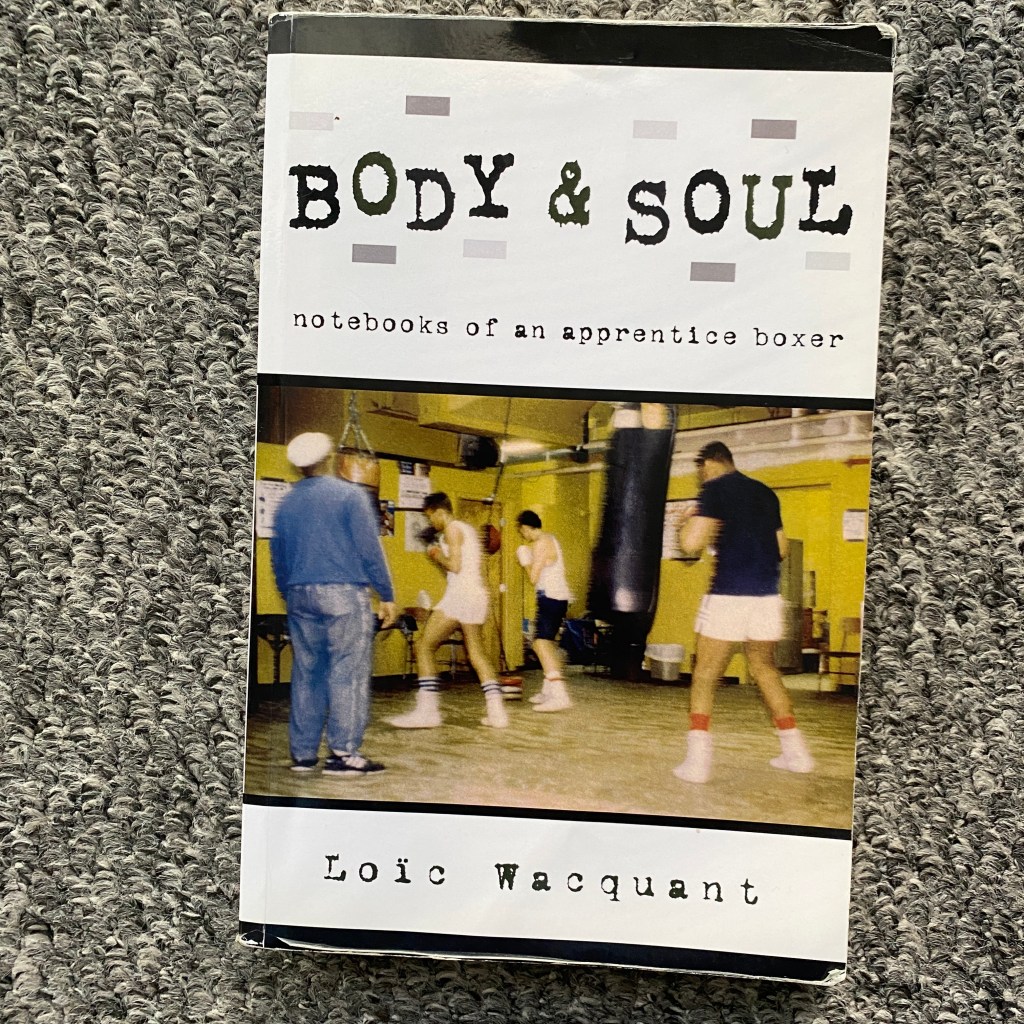
Body and Soul: Notebooks of an Apprentice Boxer, published by Oxford University Press, is Loïc Wacquant’s personal and professional account of his time spent at the Woodlawn boxing gym in Chicago’s south side.
So… I think it’s taken me nearly a year to finish this book! It’s been a bit of a battle of perseverance to get through – not because of the writing or the content but because I have been trying to read it alongside the reading I’ve needed to get done for my creative writing MA. I’m reaching the end of the course now, both in terms of timetabled classes and the space in my head to think of other things. I don’t think I’ve ever spent so long with a book, especially one that’s only 250 pages long. I’m writing about the unreliability of memory for my dissertation so maybe trying to wade through hazy memories of this book from ten months ago is a worthwhile process for my own research? Hopefully that’s the way that Wacquant would see it also. (This was actually the only boxing book recommended to me while studying for my MA, and it came from a fellow student who had previously studied sociology (or something).)
I don’t normally quote from author biographies but I think Wacquant’s own description of his work, taken from his website, is a good starting point for how he ended up at the Woodlawn gym in the first place, and then approached his research:
I am an interdisciplinary sociologist who tries to wed epistemology, ethnography, social theory, and comparison to capture the carnality of social existence; the structure, dynamics, and experience of urban marginality; the making of the penal state and the rise of neoliberalism; the specificity of ethnoracial domination and the predicament of the precariat.
It’s become clear that the main reason I struggled to stick with this book is that its academic format, if not its prose style, was too close to the reading I have been doing around time and memory. The weight and density of the footnoting in Body and Soul is at times a bit overwhelming, and often completely overrides Wacquant’s push toward an informal prose style. While this is understandable – he is an academic, and this book is a firm part of his academic output – I kept thinking throughout that the book would have been better served with endnotes for each chapter, allowing readers to follow up on particular points if they want to, rather than a third or half a page being swallowed by a footnote. Perhaps others can read with this sort of layout without being distracted, but I can’t, so I assume it must affect others. (I can’t be that much of a snowflake.)
Regardless of my recent study I think the footnoting would have bothered me, as Wacquant’s writing style has a lot of energy and intimacy and it’s a shame it gets broken up so much by an (again understandable) obligation to situate itself in a wider field of research. Unlike George Plimpton’s Shadow Boxing, for instance, Wacquant doesn’t enter the gym with the wish to ‘learn to box’. Rather he finds himself there as part of funded research into an economically deprived part of Chicago – Woodlawn gym proves the perfect social hub to meet locals, particularly those making an effort to find a space to remove them, at least for a few hours a day, from the dangers of the surrounding streets. I’m sure it was a conscious decision on the part of Wacquant’s ‘bosses’ to place this white European academic researcher in the company of a group of locally respected fighters.
The book then follows a a fairly worn trope in boxing writing: man unexpectedly finds himself in a boxing gym, then even more unexpectedly finds himself falling in love with the sport and gym life. I deliberately use gendered pronouns here as it’s with men that this trope is most rife. What is most interesting about this book (in contrast to Plimpton’s ‘journey’) is that Wacquant is genuinely surprised to find any place in a boxing gym. His doubts are fairly commonly held, revolving around ideas of machismo and brutality, but also a fairly rigid intellectual and ethical argument against the inherent dangers of boxing. Therefore, what we get with this book is a realtime (as much as you ever can with an edited text written by someone with an international reputation) revealing of discovery.
Of course, those reading who know boxers and gyms intimately might begin to roll their eyes at the thought of an academic realising that boxers are in fact human and can act caringly and lovingly toward each other. What saves this text is Wacquant’s honesty around his anxieties about his own position in the gym, and the very real concerns that anyone has getting in the ring to spar. Again, this is an argument against the current formatting of footnotes as they constantly break this development. And again, unlike Plimpton, who is only in the gym as a PR stunt for himself and his newspaper, Wacquant is very quickly training with the talented amateurs in the gym before moving on to sparring the up-and-coming pros, as well as the more seasoned ones. The book culminates in Wacqaunt competing in the local rounds of the Golden Gloves – I won’t spoil the outcome but I will say that it is a very admirably realistic result, which therefore sets this piece of writing apart from a lot of what’s on offer out there.
Now, I’m not at all qualified to judge the academic outcomes of this book, nor the rigour of Wacquant’s research, but this book did raise a more general question that I think boxing writers should consider: can those who have fallen head-over-heels for boxing, boxers and gyms ever be trusted to judge or comment on their importance or impact? Part of what appeals to me about this book is the author’s honesty about his surprise at his own desire to fall so deeply into the life and routine of the gym; of the camaraderie of the club. Because of this he gets almost as evangelical as every other boxing fan I know. Can you ever be trusted to make a fair and balanced argument for anything if you’re so smitten with it?
Of course Wacquant is self aware and professional enough to criticise where appropriate. An interesting angle is research cited in the book (annoyingly I didn’t make a note of where in the book many months ago), which shows that, contrary to the commonly held belief, boxing gyms don’t always serve those most economically deprived. (The book also makes very good and fair arguments that boxing gyms have no obligation or responsibility to make up for failings on the part of government.) This point brought to mind something I’ve been thinking about a lot as I attend amateur shows in the UK, and how it is clear that a lot of young boxers seem to be coming from quite comfortable backgrounds. Judging by the array of extravagant boots on show, as well as the expensive gloves they wear to warm up before bouts, there are clearly a lot of kids (majority?) in the sport from comfortable enough economic backgrounds that they can’t be entering the sport to escape anything.
Do young athletes now ‘need’ to come from stable backgrounds to balance the demands of elite competition? Not just the financial cost of equipment – many clubs, including my own, have systems in place to provide support, as well as providing gloves for sparring – but the stability at home to plan on the mid- to long-term around competition and training schedules.
It felt at times that this book focused too much on those boxers having (even relatively minor) success. Is it a limitation of any research taking part inside a gym that it can only ever include those who return regularly? Of course, boxers not returning are an indication of something, but can you ever be sure of exactly what? The book includes boxers and their concerns for those turning their back on the gym and falling for the lure (familiarity?) of the streets, but boxers as I know them are awful gossips and no reliable gauge for academic research.
One aspect of reading about the experiences of adults newly approaching the heavy bag and the ring are their reflections on training methods and therefore a physical pedagogy. I like all this because it highlights the borderline bemusement of coaches, and those who have known nothing but training their bodies to respond to stimuli with lightning quick responses, when confronted by anyone struggling to simply spring off their lead foot to avoid an opponent’s jab (Wacquant and the Woodlawn trainer DeeDee Armour):
Initiation into boxing is an initiation without explicit norms, without clearly defined stages […] Because the moves of the boxer are of such simplicity and obvious transparency to him, DeeDee sticks to the notion that they require no exegesis at all: “It’s easier than counting one-two-three”; “There ain’t nuthin’ to explain, what you want me t’explain?”; “We’ll see later, just box.” When one does not grasp his indications straight away, he contents himself with reiterating them, adding gestures to the words if need be, without concealing his annoyance, or else he gets angry and asks one of his acolytes to take over for him.
And if it seems like words won’t be enough:
Where are you supposed to put your right hand, uh, where? […] You don’t keep it where it’s supposed to be. I’m gonna tell Ashante to show you where you gotta keep that damn right hand.
Anyway, get this book and treat it with a bit more respect than I did, and indulge me as I finish with some of the author’s thoughts around ‘gym time’:
Gym time is a time filled, a time constrained that brands the body and fashions it according to its rhythm. Drills paced in this manner gradually habituate the organism to alternating intense effort with fast recuperation according to the tempo specific to the game, to the point where the body becomes inhabited by that necessity.
 Writers on Boxing
Leave a comment