Hi! It’s been a couple of months since I last posted. As I mentioned in my last post, I’m preparing to start a creative writing MA so have a lot of pre-reading (and writing!) that I’ve chosen to get into ahead of that course beginning.
Also, for any of you that don’t already know, Lizzy and I have started a boxing fanzine called The Spit Bucket, in which we publish poetry, prose and visual art from artists around the world, made in response to our favourite sport. We’re currently working on issue 3 which is already looking great; you can download the first two issues for free here.
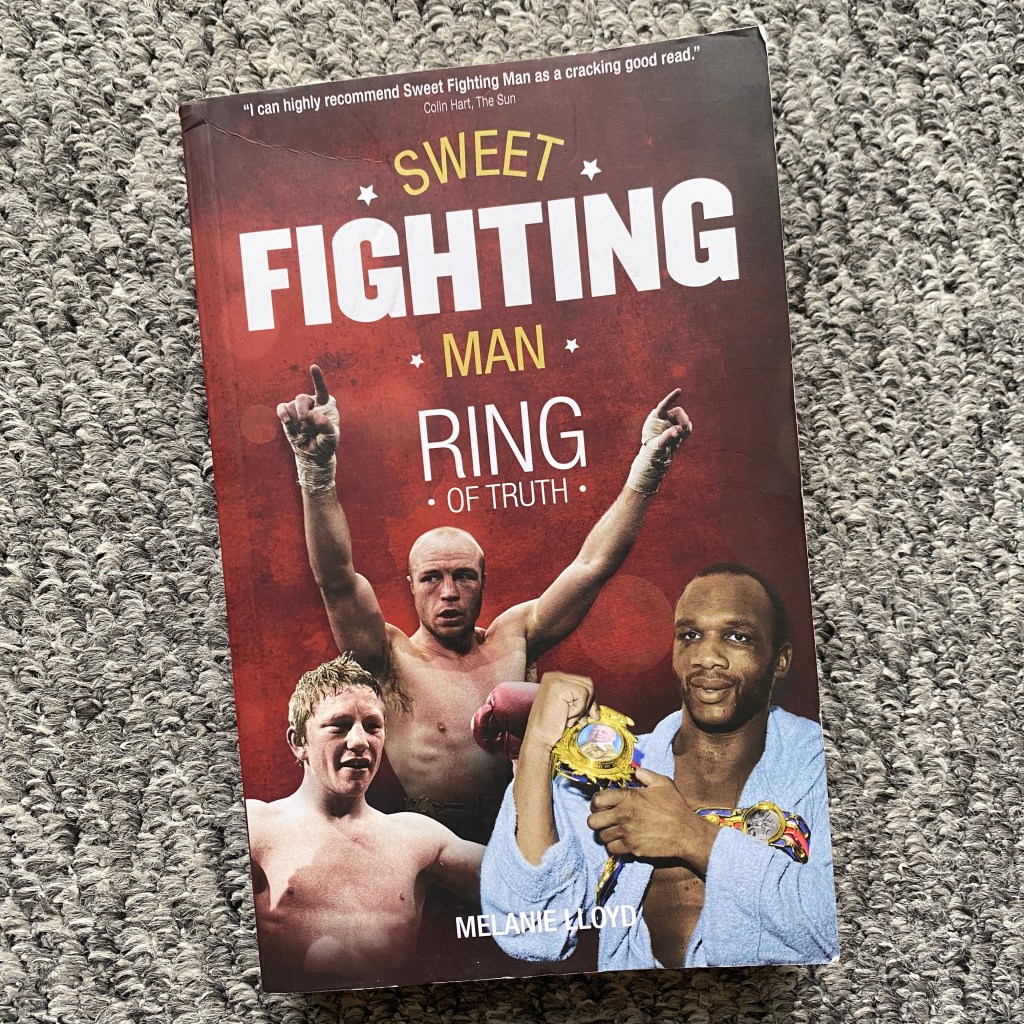
Luckily for me there is such a breadth of different writing around boxing that, even when I’m busy reading experimental fiction (yep, that’s me!), I can always find an anthology of interviews to dip into between other books. Melanie Lloyd’s Sweet Fighting Man: Ring of Truth from Pitch Publishing has been ideal the last couple of weeks to keep me in touch with the sport I love and the people who make it what it is (including the writers), while I’ve been in danger of drifting off into a world of broken narratives and disjointed perspectives.
I’ve covered books one and two in Lloyd’s Sweet Fighting Man series on this blog previously, and it’s been really fun watching her style and confidence as a writer and documentarian evolve throughout the series. From the first book, in which I’m sure – like a great deal of writers – Lloyd was just happy to be granted access to talk to some of her sporting heroes, perhaps never guessing that a physical book may emerge and then be read and enjoyed by others; through the second and onto this third book, Lloyd’s acceptance of herself as a writer and as someone who deserves to at least be at the table, talking to legends of British boxing, is clear to see.
I’ve definitely written this before, but as someone who has spent many years myself talking to people I admire, with the single aim to record their words while many are ignoring them, and to share them with others with the same passion for those stories, I’ll always have a soft spot for labours of love like this. Well done Melanie!
This book contains interviews with the following boxers:
John Thaxton talks about the importance of his family in his life and career, notably his mum who helped out by selling tickets. Like a lot of Lloyd’s interview subjects, Thaxton’s career encompassed boxing’s grittier end, with short-notice fights a regular occurrence, and the ubiquitous story of having to get himself to hospital with broken hands. It was also interesting to read of Thaxton’s pride towards holding often maligned intercontinental titles, which he is adamant provided opportunities for him that he wouldn’t have otherwise had.
Dave ‘Boy’ Green has been a figure of interest for me since I was at secondary school. I was born in Pimlico in London, but as a child moved with my parents to the Cambridgeshire fens, where I attended Cromwell Community College in Chatteris, along with Dave’s son David (year above), and his twin daughters Emma and Suzanne (two years below). There was a large framed photograph of Green at the entrance to the sports hall, where I spent a lot of time as I dreamed of becoming a professional rugby player. The school and town were, and are, very proud of his achievements, so he loomed large over all of our sporting activities.
Lloyd was introduced to Green by his biographer Bob Lonkhurst, whose book Fen Tiger I’ve written about on this blog. It wasn’t until I read and posted about this book that my dad (another Dave who had a son and called him David!) told me about seeing Green box a few times at The Royal Albert Hall, a venue where Green had most of his successful nights. By all accounts those nights were a huge amount of fun, and it seems ridiculous almost that decades after seeing Green box at a venue only a short bus ride away from where he grew up in Pimlico, my dad would move us to live only a couple of miles from Chatteris ABC, where Green boxed as an amateur (as did many of my school friends).
Sylvester Mittee was born in Saint Lucia, moving to London aged ten. Unfortunately, he faced racist abuse immediately and found himself at a local boxing club learning to defend himself. Eventually he would join Repton ABC in Bethnal Green where he notably (for me maybe) boxed and stopped Vernon Vanriel, and went on to represent Great Britain at the 1976 Montreal Olympic Games as a lightweight.
Mittee talks to Lloyd candidly about the pressure as a young pro to sell tickets for bouts, particularly to a community that perhaps didn’t have a lot of spare cash at the time, and the mental demons and doubts he needed to overcome after losses.
As happens a lot when you spend a lot of time around boxing, names and faces pop up suddenly in your memory: earlier this year Lizzy and I were up in Derby watching the national amateur finals and a man came over to ask me if I had anything to do with St Pancras ABC, as I’d been cheering so loudly for Jermaine Dhliwayo as he lost on points to a very classy Will Hewitt (Leigh). I don’t – it was just a London bias on my part. Anyway, that man turned out to be Chris Sanigar, who Mittee beat in 1982 to win the Southern Area Super-lightweight title.
Steve Holdsworth went on to have a successful career commentating for Eurosport. I really enjoyed this interview, in which Holdsworth talks with a lot of humour about his career, like this quote about fighting Robbie Robinson: “I think he decked me in the first round and, let’s face it, who didn’t? I was always on the floor. I got a cauliflower arse, I was down that often.”
It’s rare to hear a boxer talk about their career with nothing but positivity and contentment. There’s usually some mild resentment about an opportunity that slipped them by, or a tight decision that went against them. The fact that Holdsworth only had 12 professional fights, in a career in which he openly says he expected to achieve nothing, probably goes a long way to explaining why he is so at ease when looking back.
Colin Lake found his way into boxing first as a kid growing up in Holloway, north London, then as an apprentice jockey at a time when to be the stable’s lad champion was a very high achievement. As a professional Lake had an early, traumatic setback when his opponent Lyn James unfortunately died from injuries suffered during their bout on 16 June 1964. Lloyd sensitively gets Lake to open up about the devastation he felt after this tragedy, and the effect it had on the rest of his career as a boxer and trainer. Shortly after James’s death Lake received words of comfort and encouragement from Sugar Ray Robinson, who had experienced similar.
Lake went on to have an enormous influence on a huge number of amateur boxers, first by establishing New Astley ABC in Newmarket, where he had been apprenticed, and then coaching at Angel ABC (a club which has links to Islington ABC where I regularly train). And in keeping with talking about coincidences, Angel ABC’s only national amateur champion is Patrick Gallagher, who beat Billy Schwer (see below) at 60kg in 1990.
Lake also had success as a professional coach, training the likes of Ivor Jones, Colin Dunne and John Ryder – all while maintaining a strict policy of only ever training one pro at a time, to dedicate his attention to them.
Johnny Kramer from east London turned professional aged 18 in 1959, signing a contract with Sam Burns and Jarvis Astaire. He trained at the famous Thomas A’Becket pub on south London’s Old Kent Road, where he once sparred South African Willie Toweel while he was in London to fight Dave Charnley. A highlight of Kramer’s career was boxing against Johnny Pritchett at Highbury stadium, in 1966, on the undercard of Henry Cooper vs Cassius Clay.
I liked this quote from Kramer, reflecting on being declared the loser against Jimmy Tibbs at York Hall in 1970, a bout he (and the crowd) felt he should have won: “I have to say that’s the only time that I’ve ever felt like putting my foot on the bottom rope and helping the referee out of the ring by kicking him up the arse.”
Bunny Johnson, born in Jamaica, became the first black boxer to win the British heavyweight championship when he beat Danny McAlinden at Grosvenor House, Mayfair in 1975. Johnson was a direct beneficiary of the British Boxing Board of Control deciding to allow boxers born overseas to compete for British championships, providing they had been living in Britain for at least ten years. He also went on to win the light-heavyweight version.
A pretty bizarre highlight of Johnson’s career is that in 1979 he travelled to the US in order to fight James Scott, who at the time was serving a sentence at Rahway State Prison in New Jersey. Johnson would finish his pioneering career on the road boxing in Denmark and Australia.
Billy Schwer, from Luton, was first trained by his father before he stepped aside, allowing Jack Lindsay to take over. Schwer had a great career, in fact a pretty glittering one, in comparison to most of Lloyd’s interview subjects. He picked up British, Commonwealth and European lightweight titles on his way to a number of unsuccessful world title attempts. He finally broke through that barrier when he won the IBO version of the Super-lightweight world championship by beating Newton Villarreal at Wembley Conference Centre in 2001.
He retired after contemplating the injuries he sustained when losing his IBO title in his first defence against Pablo Daniel Sarmiento. After some troubled times away from the ring, and adjusting to life away from boxing, he found his way to becoming an ‘inspirational speaker’, working with businesses, sports clubs and charities to spread his message of what he thinks it takes to become a champion.
A quote stood out to me when Schwer was talking about his motivations for what he was trying to achieve after boxing, and it reflects an attitude I pick up on a lot from boxers I talk to; it reflects their self-doubt, and perhaps and underlying lack of self-esteem. It’s hard to know whether such a tough and unrelenting sport such as boxing will ultimately lead all participants to question their self-worth: how can they ever be good enough when the sport they’ve chosen can’t ever be mastered, and their biggest opponent is their own anxiety? Or does boxing attract youngsters who are already prone to bouts of deep introspection?
“[during my career] I looked at every possible angle that was going to improve my performance and I do that now. I’m in full-time education. I’m studying. I’m reading. I’m grafting. I’m still trying to prove that I’m good enough.”
Joe Somerville had the kind of career I love to read about: Essex Regiment light-heavyweight champion while serving in the army, then a lengthy stint boxing in the boxing booths for Alf Weston, and then making a name for himself as a reliable and capable pro who would box anyone a couple of weight divisions either side of middleweight, and at very short notice. Even being deemed a worthy sparring partner for the great Emile Griffith when he was in the UK preparing to fight Brian Curvis in 1964.
I really enjoyed reading about Joe’s experiences in the booths, and his descriptions of Alf Weston’s spiel as he whipped up the local crowds using jollys (plants) in the crowd, who would be brought up on stage and declare that they were from a neighbouring town (young men are so easy to wind up!) before they entered into a gee (staged fight) with the booth boxers, who would allow them to look good and fool the audience into thinking they had a chance of going the distance or maybe even scoring a knockout.
Joe sounds like he was a fantastic character, and that the London Ex Boxer Association meetings (which I really need to get a along to!) are a slightly duller affair for not having hm around any longer. I’m going to end my blog post with a selection of names that Joe gave himself while boxing in the booths:
Ernie Schmockle
Sebastian Fandango
Elmer Snodgrass
Harry Greenballs
Napoleon Nutmeg
Mr R. Soles
Wellington Chesterfield
Thadieus Scratchpole the Third


Leave a comment