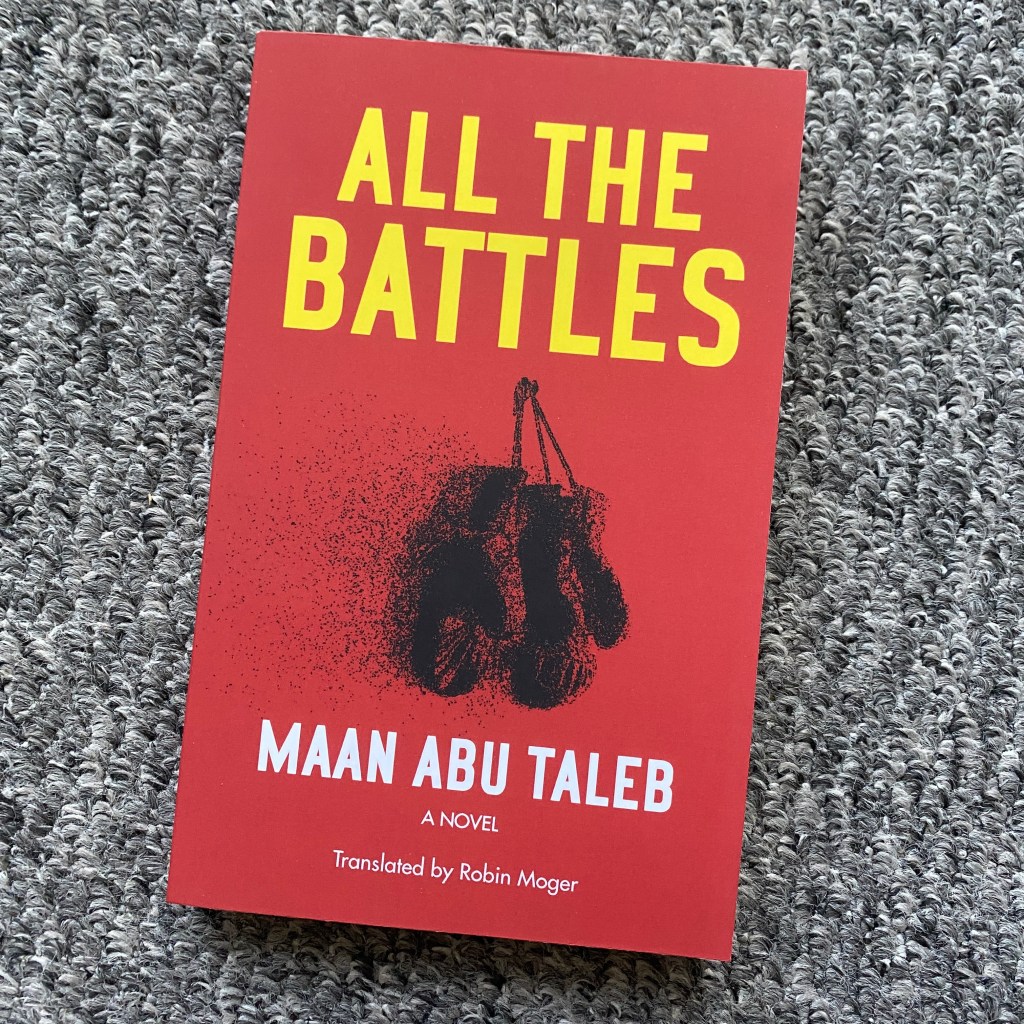
‘All The Battles’ is a boxing-themed novel written by Maan Abu Taleb, published by Hoopoe Fiction in 2017 and translated into English by Robin Moger.
The book follows advertising employee Saed Habjouqa as he develops an internet-based obsession with boxing, which eventually leads him to seek out a famed gym to train for himself. Not only does this new obsession take him out of his comfort zone physically, but it literally takes him across town from his own privileged neighbourhood to a poorer area that he is completely unfamiliar with. Out of his depth in the ring, and immersed in a new class stratum, Saed is left no option but to try and prove himself through commitment to his training.
Saed not only faces judgement from his new gym-mates, but also from his work colleagues, friends, his own family, and that of his girlfriend Dina, who all see boxing as below a man of his upbringing. His attempts to hide his involvement eventually fail when the physical effects of sparring intensify and he’s left bruised and swollen from the ring.
Eventually his commitment to boxing, and the need to ‘go into battle’ in the ring, allows Saed to connect emotionally and spiritually with his forefathers, many of whom were freedom fighters against invading Russian forces, and all from much poorer and humbler roots.
The novel falls into the same traps as most boxing fiction in that it condenses the protagonist’s career dramatically, leaving that element completely unrealistic in order to deal with the story arc in a manageable timeframe. I’ve tried not to, but I’ve failed again to not let this area of boxing fiction annoy me. In the case of this book, Saed is offered the chance to turn professional after a handful of amateur bouts (where he’s bashed about cinematically in bouts which definitely would have been stopped), in a ten-rounder against a solid career pro.
That aside, I really liked the quality of the prose in this book, so another mention should go to Robin Moger who translated the story from the original Arabic text, and has retained a fluidity and pace which isn’t always present in translations. All The Battles is one of the best novels I’ve read which captures the initial secret excitement that people often experience when discovering the sport later in life, and gives a really good idea of just how much someone might need to sacrifice just to be a fairly mediocre boxer, with the boxer in question here eventually showing great promise.
The repetitive nature of boxing training, both as a beginner, a novice, and then as a skilled athlete, is portrayed realistically but with engaging skill by the author and translator. As is the effect that these sacrifices end up having on those close to the boxer: the worry and fear and eventual resentment at feeling pushed away or overlooked in favour of training.
In the current climate it’s interesting to read a boxing book set in an Arab state (Jordan in this case) which, within the story, is looking to capitalise on local interest in boxing and promote the sport throughout the wider region. Part of the reason for Saed’s rapid rise through the sport’s ranks is a desperation to find and promote a marketable and ‘respectable’ Arab fighter. I don’t know if this book can offer any insight into what is happening at the moment in Saudi Arabia, it’s more likely that I feel this way because of the coincidence in timing.
There are also deeper and more philosophical questions asked of the sport throughout the book, by Saed’s trainer Captain Ali, such as:
“[…] You get luck in basketball, in tennis, in soccer – pretty much every sport, with the exception of boxing.”
The captain leaned back in his chair and took a drag of his cigarette. He rocked back and forth for a while then looked up at Saed. “Is boxing even a sport?” he asked.
“I don’t know,” Saed responded.
“Neither do I,” the captain said.
and…
Boxing was a lie. The fully fledged fighter lies in every aspect of his profession. He threatened as he shook with fear, seemed exhausted while he pulsed with energy, leaped to the attack when he was worn out and craved a rest. Stepped right then went left; dummied a left then threw a right. Deceptive statements about fun and the like were not so much directed at the opponent as designed to help the boxer himself, dressing up his fears in an arrogance that would keep him going, and only then going to work on the man he’d face.
As with all good boxing prose you can clearly see the influence of Joyce Carol Oates on the author’s own musings on the condition and position of the sport and its participants.


Leave a comment