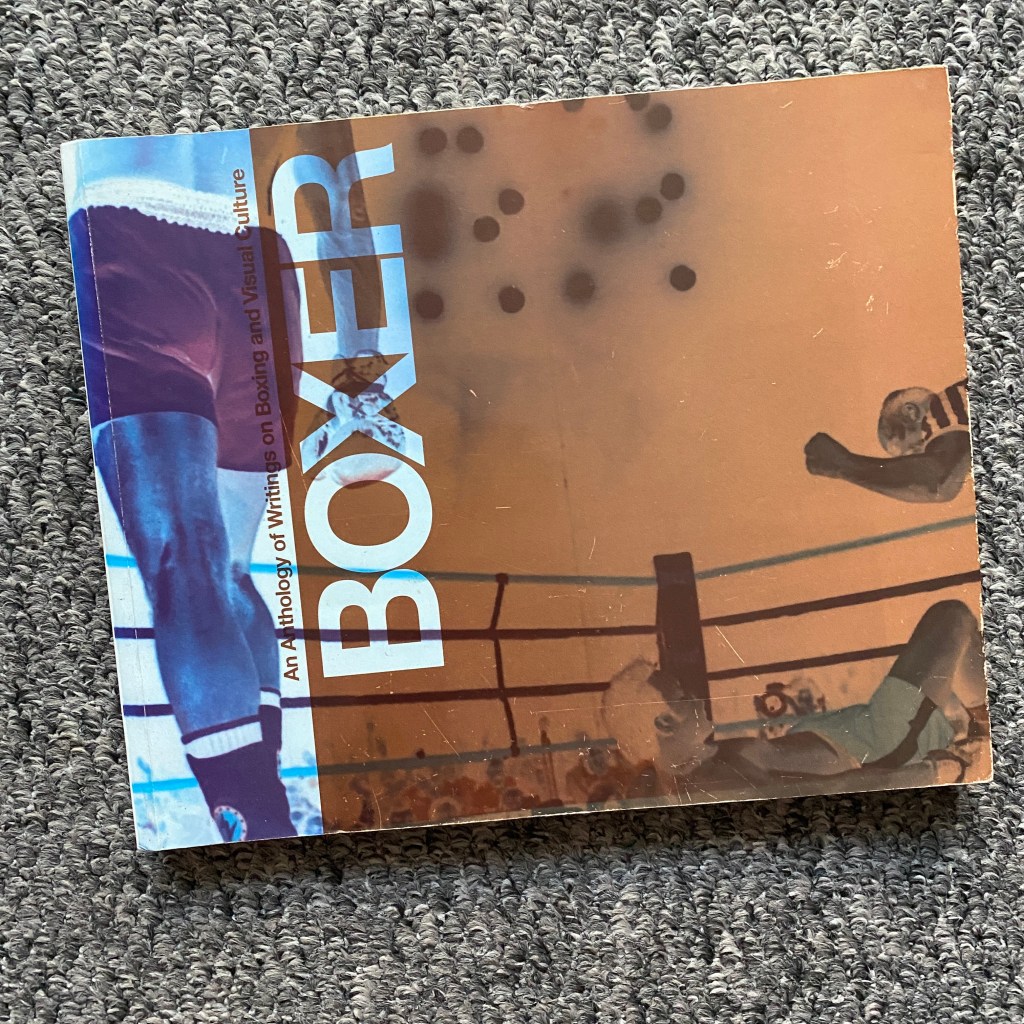
Edited by David Chandler, John Gill, Tania Guha and Gilane Tawadros, ‘Boxer’ was published to accompany an exhibition of the same name at Walsall Museum and Art Gallery (29 July – 10 September 1995).
This anthology of essays stands out within my collection as it’s the first boxing-related book I’ve read which can be described as an ‘art book’, in that it combines high quality images of boxing-inspired artworks, displayed with equal prominence alongside the musings on boxing in art and culture. It also represents a bit of back-tracking on my part, as I had sworn off buying more art books due to lack of funds and space in our small flat (and because sometimes you have to make a change, move on and realise when you’ve got an obsession that no longer fulfills).
To support the exhibition, the editors of this book commissioned ten writers to explore different aspects of boxing’s relationship to [European and American???] visual arts. Following an introduction by editor David Chandler, and an excerpt taken from Joyce Carol Oates’ ‘On Boxing’, the essays are as follows:
- ‘Pugilism, Painters and National Identity in Early Nineteenth-Century England’ by Marcia Pointon: Pointon explores the impact that boxing and the bodies of boxers had on the visual arts in late-Georgian England, at a time that national identity was being politicised and weaponised, particularly as a rejection of ‘the foreign’ or ‘European effeminacy’.
- ‘From Joe Louis to the Slugger – Boxing Mediated’ by Ian Jeffrey: Looks at the way that boxing was captured by early photography and how developments in photographic technology were utilised to not only report about the sport through a booming newspaper trade, but to help market the drama of the sport and build icons and villains within it, with these techniques going on to inform how boxers were then represented on film.
- ‘James Coleman’s Box (Ahhareturnabout)’ by Jean Fisher: Fisher breaks down James Coleman’s 1977 art film, ‘Box (Ahhareturnabout)’, which features footage of Gene Tunney’s second bout against Jack Dempsey. Fisher examines the language used in the film – written, spoken (verbal and non-verbal), and visual – as a way to describe its importance and impact.
- ‘Skin Tight’ by Glenn Ligon: A reflection on the social impact of Muhammad Ali’s sporting achievements, and his equally impactful stance on the Vietnam war and racism in America and globally. This essay also touches on the influence of Ali’s words and physicality on Ligon’s own artwork ‘Skin Tight’.
- ‘Four Corners, A Contest of Opposites’ by Keith Piper: This essay focuses on the impact made by black boxers throughout the 20th Century, perhaps unsurprisingly focusing on the careers of Jack Johnson, Joe Louis, Muhammad Ali and Mike Tyson.
- ‘The Ring of Impossibility, or, the Failure to Recover Authenticity in the Recent Cinema of Boxing’ by David Alan Mellor: Mellor investigates boxing’s connection to modern (at time of writing) cinema under the following headings: ‘The Afro-American Manager as Despot’; ‘The Boxer as Sacrificial Beast’; ‘The Pompous Boxing Body and National Baroque’; ‘Boxing, Transformed by Promotional Culture, as Agent in the Geography of Moral Corruption’; ‘A Hyper-modernised Simulacra of Boxing’; ‘An Ugly Crowd Gendered as Female’; ‘The Boxer’s Statue and Masculine Apotheosis’; ‘The Procurement of Honour’; ‘The Gym as Site of Authenticity and Male Presence, to the Edge of Hallucination’; ‘Patriarchal Traces, Talismans and Fetishes’.
- ‘The Noble Art: Boxing and Visual Culture in Early Eighteenth-Century Britain’ by Sarah Hyde: Taking William Hogarth and James Figg as her examples, Hyde compares the developing fate and professional standing of painters and boxers in 18th C Britain.
- ‘Arthur Cravan: Stances of the Century’ by Roger Lloyd Conover: Conover’s portrait of poet/boxer Arthur Cravan.
- ‘Raging Bulls: Sexuality and the Boxing Movie’ by Nick James: Another examination of boxing’s influence over American movie-making, focusing on the latent homoeroticism within the sport, the role of women as bystanders and onlookers, and the question of what is it to be a man and what is masculinity?
- ‘Bruising Peg to Boxerobics: Gendered Boxing – Images and Meanings’ by Jennifer Hargreaves: Hargreaves traces women’s participation in boxing from the 1700s in Britain until the 1990s, while focusing on the stigma they have always faced for wanting to express any form of aggression, and the unfounded biological concerns that objectors held for a long time. There is special mention of ‘Battlin’ Barbara Buttrick, Women’s World Fly and Bantamweight champion in the 1950s and 60s, and first president of the Women’s International Boxing Federation. The essay also asks if, in the general (modern day) rush for equality in the sport, adequate questions have been asked about the health and safety of the women taking part, and if enough has been done to inform new participants of the potential risks involved.


Leave a Reply