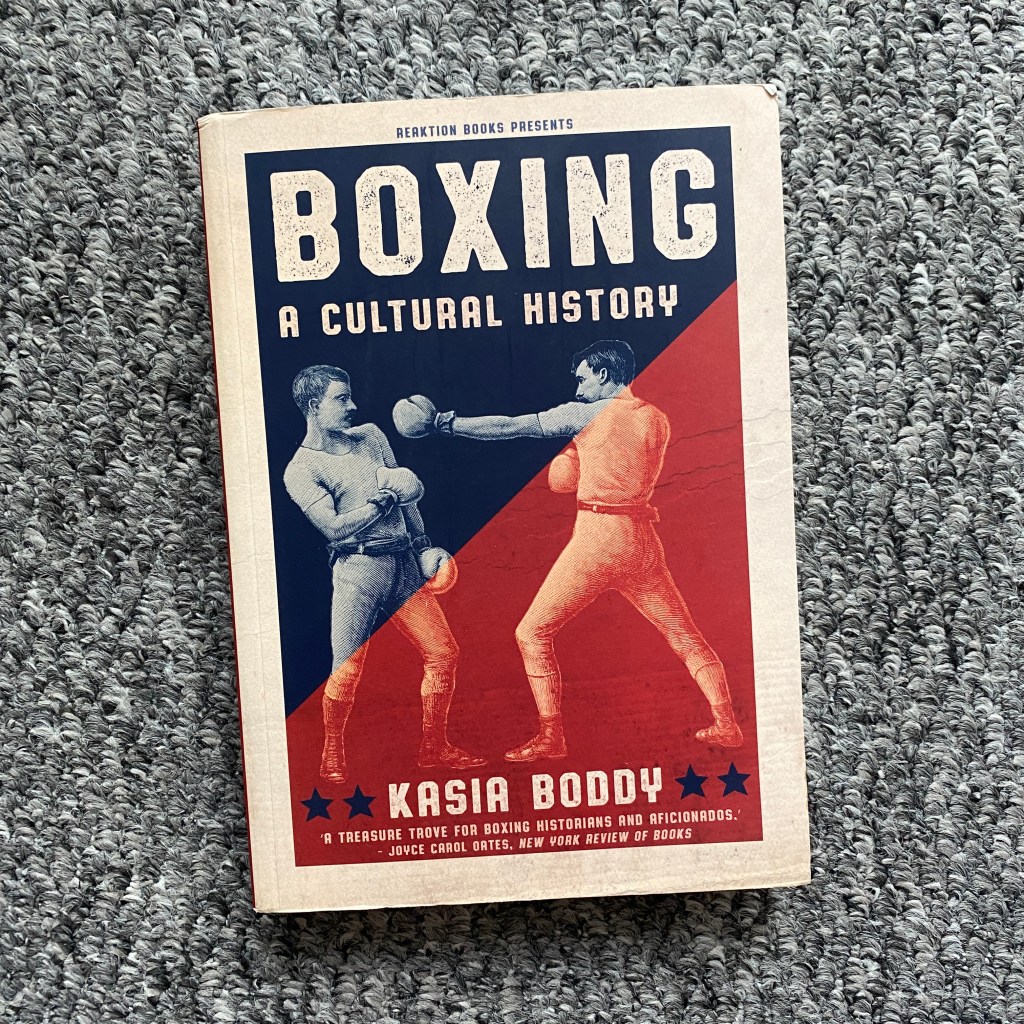
‘Boxing – A Cultural History’ is Kasia Boddy’s comprehensive attempt to document boxing’s influence over, and its own responses to, the many cultures it has existed in. It is published by Reaktion Books.
First off, I have to say that this blog isn’t really an adequate space in which to attempt any form of response to a book as extensive and deeply researched as this. It’s rare to come across books as thoroughly structured and dense as this in any genre outside of academic collections, never mind a book about a sport. Though, those of you reading who have been bitten by the boxing-bug will no doubt agree that boxing as a subject deserves to be treated with the level of reverence and respect that Boddy has demonstrated in this publication.
I’ve been going back and forth trying to come up with an approach to respond to this book beyond simply saying, it’s really very good, go and buy it! What I’ve settled on is to simply go chapter-by-chapter, giving an outline of the themes covered in an attempt to give an outline of the subject matter. Even with this approach I’m not going to come anywhere close to doing it justice.
Chapter 1:
The book begins with the earliest cultural references to boxing from records left by Ancient Greek and Roman writers. There is an interesting thread here about boxing as ‘deep play’, which I will definitely try to do more reading on. As an extension of this idea boxing was introduced to the ‘great games’ of the periods, eventually leading to boxing’s inclusion in the original Olympic Games. Champions of these games were eulogised in poems and odes, with the greatest champions becoming mythical characters.
To prove just how we have not progressed societally, Boddy quotes records of corruption during the 98th Olympic Games (388 BC) – this made for ironic reading during the weeks that the IOC was considering whether to include boxing at all in future games. Another reflection of the modern sport was the early distrust of ‘pretty’ boxers, with the assumed conclusion of any bout to be serious damage to the body of the winner as well as the loser.
Chapter 2:
This chapter focuses on the ‘English Golden Age’ of boxing, during the 18th C. This was a period of radical change to the form and function of bouts, with the introduction of rules in 1743 by Jack Broughton, weight categories following on from the system of handicapping in horse racing, and the use of ‘mufflers’ (gloves) to protect ‘gentlemen’ of the period from facial injuries when sparring.
As well as in writing, the sport was heavily documented in the form of engravings and mezzotints.
A strong concern of this period was the English preoccupation with rejecting ‘foreign effeminacy’, in attempt to evoke classical ideals with the general idea that an Englishman should consider himself lucky to be English. This sense of ‘fairness’ and structure fed heavily into the ideas of colonialism which eventually spread across the globe. Of course, this sense of fairness and structure often only applied when it suited the established power system.
Chapter 3:
The book reaches the early 19th C with artists and writers using pugilism as a source of inspiration for subject matter and basis for method. By the 1820s Pierce Egan, William Hazlitt and John Hamilton Reynolds were all drawing heavily on pugilism as a subject, either as a source for essay writing or journalism. Egan in particular sought to document pugilism as a social influencer, focusing on and using the language used by ‘The Fancy’ (boxing spectators) in the form of slang or ‘flash’.
As a (reformed) poet myself I was very interested to read of writers of this period appropriating the language of the working class:
Byron and his friends were attracted to the Fancy’s dialect because it ‘was fashioned to hide meanings from outsiders’. Indeed as Thomas Moore put it in the preface to his satirical poem ‘Tom Cribb’s Memorial to Congress’, flash ‘was invented, and is still used, like the cipher of the diplomatists, for purposes of secrecy’. What that secrecy meant to upper-class ‘fanciers’ like Byron is a matter for speculation.
This quote caught my attention as this appropriation is still common practice among poets in the UK as they attempt to appear more working class, urban or young and fresh. It isn’t always possible to understand their motivations but it is almost certainly centred around a guilt attached to acknowledging their own privilege, but also, perhaps, an attempt to make their work seem more appealing to funding bodies. Due to a lack of other resources, the working classes, regardless of their make-up, will continue to further develop an inventive and colourful poetic language – only for the cycle to begin again.
Another fascinating, poetry-related aspect of this chapter is a reference to my wife’s favourite poet (who I have written about in a previous project), John Clare, who it also seems had been thoroughly bitten by the boxing-bug. He said this about a trip with Oliver Rippingille to Jack Randall’s Hole in the Wall in Chancery Lane to watch some sparring:
I caught the mania so much from Rip for such things that I soon became far more eager for the fancy and I watch’d the appearance of every new Hero on the stage with as eager curosity [sic] to see what sort of fellow he was as I had done the Poets – and I left the place with one wish strongly in uppermost and that was that I was but a Lord to patronize Jones the Sailor Boy who took my fancy as being the finest fellow in the Ring.
And this from Boddy relating to his later years when a psychiatric patient:
In the Northampton asylum in which he spent the last years of his life, Clare adopted many pseudonyms and alter egos, including those of the prize-fighters he had watched on that trip to London.
The chapter ends simply with the line, ‘The golden age of boxing was over.’
Chapter 4:
During the early Victorian period the popularity of, and interest in, pugilism starts to wane as society begins to view it as ‘ungentlemanly’ and juvenile, and eventually as deplorable. Prize-fighting was seen very much as an activity indulged in by the lower classes, and in no way an activity for a gentleman to associate himself with. This idea was of course contradicted by the fact that prize-fighting was financed and supported by men of means from the upper echelons of society.
If it was considered bad form for men to associate with pugilism then the view taken on women who showed an interest was even harsher. Newspapers of the era carried regular jokes, articles and cartoons mocking women attending fights.
Toward the end of the Victorian period amateur boxing and sparring became wrapped up in ideas of social reform (and its associated classist bullshit). Boxing became a ‘tool of education’ in English superiority and sportsmanship. A tool for dictating to the masses how and when they should fight, and as an extension of how and when they should use their bodies. It’s no surprise that the Amateur Boxing Association formed in 1880 with the motto ‘box, don’t fight’.
Chapter 5:
From the 1880s to the 1920s boxing was in a state of flux. One set of codes and regulations replaced another, British dominance collapsed in the face of new American prowess, and new audiences emerged through the development of popular mass media from magazines to film.
During this period, post the introduction of the Queensberry Rules (1867), bare knuckle heavyweight boxers began transitioning to ‘gloved’ bouts, with US states legalising boxing before repealing these laws. Boxing as we now know it was finally legalised in New York in 1920. With these developments boxing leant itself to being filmed, as the arena in which bouts took place was far easier to capture with early and unwieldy cameras, more so than in other popular sports of the time such as baseball. The first boxing film was produced in 1894 and featured Mike Leonard and Jack Cushing as its protagonists.
Eadwerd Muybridge famously used boxers as subjects in his hugely influential early film studies of human movement. Theses studies have influenced generations of visual artists including, most importantly for my own writing and artistic sensibilities, the paintings of Francis Bacon. Viewed through Muybridge’s eyes (lens) it’s easy to see why the roped boxing ring was so attractive to painters and later to filmmakers.
This chapter also focuses on the paintings of boxers by Thomas Eakins, who took it upon himself to teach a form of ‘manly painting’. A notable student was George Bellows, who also became known for his paintings of pugilists. It was, however, interesting to read how the former’s focus was on the boxers themselves, while the latter often depicted the boxers as blurred brushstrokes, with the distorted faces of the spectators equally prominent at ringside. This focus seems a natural extension of Egan’s fascination with The Fancy, but also a shift toward analysing why audiences found the ‘brutality’ of boxing so appealing and engaging.
Chapter 6:
During the early 19th C there was an enormous influx of Jewish, Irish and Italian migrants to the US, and by the 1920s and 30s boxing in the US was dominated by the children of this first wave of migration, with this dominance also being reflected in Britain by the success of a number of Jewish fighters, such as Jack ‘Kid’ Berg.
This was also the era in which most major sports in the US upheld segregation laws and boxing was no different, maintaining a colour bar, particularly when it came to the heavyweight championship. As with baseball and American football, boxing became embroiled in a wider struggle to maintain white supremacy. Eventually the colour bar was broken by Jack Johnson in 1908, after he travelled to Australia to fight and beat Canadian Tommy Burns. Unfortunately Johnson refused to defend his title against any black boxers, opting to reinforce the colour bar himself. It was during Johnson’s controversial reign as champion that the idea of ‘The Great White Hope’ emerged, in direct response to the idea that:
What was supposedly ‘new’ about the much discussed New Negro was not aggression but retaliation; not a desire to fight, but a renewed willingness to fight back.
Also featured in this chapter is the writer Ernest Hemingway. Hemingway is somewhat of a cloud hanging over this blog as it seems impossible to continue much further without featuring his work in and around boxing; but I just have no desire to spend any time thinking about someone I have such a lack of respect for. To expend energy on someone that was so bent on turning artistic endeavours into acts of competition seems a complete waste of time. I have similar but milder feelings toward Norman Mailer.
Conversely, the chapter shines a brilliant light on the influence of boxing, in culture, over the work of James Joyce. This is a topic I will definitely be looking to do more reading on, especially since the influence rode parallel to Joyce’s own rejection of the sport:
According to Stanislaus Joyce, his brother [James] ‘detested rugby, boxing and wrestling,’ which he had to take part in at school, and ‘which he considered a training not in self-control, as the English pretend, but in violence and brutality.’
Chapter 7:
I’ve got a feeling that my thoughts about this chapter will stretch much further than for the other sections of this book, covering as it does boxing’s influence over 1920s and 30s art movements such as Constructivism, Dadaism and Futurism. Even before I had found myself lost in the world of boxing writing I would, whenever possible, immerse myself in reading about the artistic ideas of this period.
With the start of the 20th C, and the end of WW1, boxing was dragged to the forefront of mainstream media due to its compatibility with film and TV, its continued expansion via radio, and the American reverence for sports writing as newspaper sales continued to soar. This chapter begins by highlighting the professional relationship between promoter Jack ‘Doc’ Kearns and his heavyweight champion Jack Dempsey. The pair developed methods to sell fights like no one before them, wringing every last possible amount of interest out of a viewing public, leading to the first ever million-dollar gate receipts for a bout.
Kearns’ method of marketing fights as the meeting of polar opposites – rough and ready working man vs European ‘dandy’, draft dodger vs war hero, good vs evil – would go on to influence the way that just about all major championship bouts were marketed, up to the present day. As an extension of this, Kearns was the first major promoter to regularly aim tickets at women, with dedicated seating areas at bouts – there is an essay to be written here, comparing Kearns to the British promoter Eddie Hearn, who has positioned himself as a leading proponent of women’s boxing. This essay would of course need to incorporate the binary view that the very positive and forward-thinking efforts made toward inclusion and equality exist under a murky cloud of capitalist desire to double the promoters’ market share.
With the increase in media reach at a time when dedicated publications such as The Ring Magazine were being founded (Nat Flesicher, 1922), a new (now familiar) print language was being developed:
[…] what sociologist Leo Lowenthal identified as a distinctive 1920s ‘language of directness’. At the very moment when ‘modern institutions of mass communication’ were promising ‘total coverage’, he argued, journalists increased their use of ‘you’ or ‘we’ to create a compensatory sense of intimacy between writer and reader.
These same print outlets also chased after the potential new female audience by engaging women to write boxing columns, though all too often this was merely to give a ‘woman’s view’ of the sport, repeatedly focusing on the physical condition of the boxers and their romantic interests. Of course, there were women who stood outside of this, such as Djuna Barnes, who wrote about the experience of attending a prize fight with female friends.
It’s hard to imagine now how utterly modern and new America looked during this period when viewed from Europe, a continent still under the cloud of the loss and destruction of WW1. To many artists and writers America was the future:
In Germany in 1916, the painter George Grosz was certain that America represented ‘the future’. It was not, however, the country itself that excited him so much as ‘Americanism’, which he later defined as ‘a much used and discussed word for an advancement in technical civilization that was permeating the world under American leadership.’
Bertolt Brecht shared this view but he also saw sport, particularly boxing, and the open and egalitarian mode of spectating, as a model for the democratisation of art. Brecht was in agreement with a number of leading European artists, that many European countries were mired in a sense of sentimentality and idealism for a(n imagined) time past:
‘The stadium vanquishes the art museum,’ declared Hannes Meyer in 1926, ‘and bodily replaces beautiful illusion. Sport unifies the individual with the masses.’
Interestingly, boxing was held as an ideal by those both on the Left and the Right of the political spectrum, with the Right wanting to use the sport as a way of proving racial and ethnic superiority, and the Left seeing access to sports as a pathway toward a more egalitarian society.
An assumption that I had always made, that the Soviet Union had always embraced boxing, was challenged and overturned in this chapter. Apparently, boxing tournaments were introduced in Moscow during the 1920s, though these occurred while debates were ongoing as to whether a solo sport like boxing could ever be used to promote Socialist ideals. Ironic really, considering how Soviet training methods formed the bedrock of decades of Cuban Olympic domination in the sport.
Obviously, the supporters of boxing won these political debates and the popularity of boxing, both as a sport and a symbol of Soviet and Socialist strength, heavily influenced Soviet Constructivist artists such as graphic artists, the Stenburg brothers. This fascination with ‘the new’, and a general feeling that boxing could be the Old World’s link to the New World, permeated the Futurists’ attempts to capture action and link advancements in film to the painter’s canvas, as well as Dadaist attempts to reject what they saw as ineffective and outdated modes of communication:
[…] point three of the ‘Initial Manifesto of Futurism’ (1909): Literature has hitherto glorified immobility, ecstasy and sleep; we shall extol aggressive movement, feverish insomnia, the double quick step, the somersault, the box on the ear, the fisticuff.
Chapter 8:
In a 1933 sociological study of ‘Americans at play’, Jesse Fredrick Steiner noted a ‘growing interest in amateur boxing’; an interest, he argued, which had been stimulated by ‘the Golden Gloves Amateur boxing contest sponsored by the Chicago Daily Tribune and the New York Daily News’. Such events, he maintained, ‘demonstrated that the sport can draw large crowds when conducted as a boxing match and not as a prize fight’. Steiner’s comments suggest that the increased appeal of amateur boxing was due to a sudden revival in sporting spirit, but mass unemployment was probably a more significant factor.
During the 1930s, boxing as subject matter was very popular in Hollywood, with the mainstay of storylines focusing on the cliched rags-to-riches story of ‘local boy makes good’. With mass unemployment and social inequality prevalent around the globe, boxing was seen as a way for working class men to earn considerably more money than they could working the few jobs available to them. The short-term and, frankly, unlikely nature of this was often overlooked in these films, with the hero of course always making their way at the end. Ironically, this same struggle features in gangster or mob films of the time, with the same men from the same neighbourhoods fighting the same oppressive forces, and trying to get by in an unfair world.
The boxers and gangsters became further entwined in films of the 1940s, as producers began to focus on the influence of the mob and the corruption encouraged by their presence in the fight game, fixing fights and controlling major fight venues, and therefore controlling who got the opportunity to fight for championships.
An element added to films of this earlier period is the ‘woman’s gaze’ upon the boxers, but only ever as a way of framing the man’s masculinity:
Boxing stories, in some way or another, are always about the anxieties of boys and the ways in which they test and define their masculinity.
While scenes such as this put boxing films firmly into the category of male weepie, it is worth remembering that the most important spectators within the films are always women. ‘Boxing movies may describe the world of men and male values,’ noted Ronald Bergan, ‘but it is the women in the background that give them meaning.’
Through the films of this era, boxers attained the position of cultural icons beyond the sport, becoming advertising commodities, stage stars and restauranteurs.
Chapter 9:
The final chapter of the book focuses on television’s influence on boxing, both in the way that it made the richest promoters and boxers even richer, and the way that it, in the opinion of A.J. Liebling (and others), killed off small hall shows around the US.
Due to the nature and structure of the sport, boxing was relatively easy to film and broadcast, as well as being easy for the viewer at home to watch on early TV sets. The one-minute break between rounds meant that the sport was an advertiser’s dream, and led to years of regular scheduling on US national TV on Friday and Saturday evenings, with sponsors such as Gillette and Pabst Blue Ribbon having their brand names beamed into millions of households every weekend.
The importance of TV led to a fundamental change in the way that promoters and managers handled their fighters. No longer was it most important to be ‘in’ with the men responsible for booking fighters at venues such as Madison Square Garden; rather, they needed connections amongst the executives at the burgeoning TV networks to get their fighters the opportunities they needed to work their way up to a title shot.
Later, and with dwindling viewing figures as audiences gained more choice of programming, TV eventually grew colder toward the sport and began dropping boxing from its schedules. This was only reinforced by the jailing of Frankie Carbo and the breaking up of the International Boxing Club, both of which events highlighted the corrupt links between the sport and organised crime.
… then came Cassius Clay, later Muhammad Ali, who almost single-handedly dragged the sport into a more modern age, pulling TV interest into his orbit. Along with his undoubted boxing genius, his charisma and activism pushed boxing to the forefront of the Civil Rights movement. Ali, of course, wasn’t the only black sportsperson responsible for this, but his stand against the Vietnam war undoubtedly made him the most famous and prominent. This chapter also discusses, at length, boxing’s relationship to and influence on 1970s Black Cultural Nationalism, which it seems was both supported and opposed.
Once again boxing found itself attractive to middle class artists looking to re-identify, or to shake some of their comfortable upbringings from their public personas. Mentioned in this chapter are the attempts in this regard by Norman Mailer and Bob Dylan. Mailer, as with Hemingway, Hazlitt and Pierce before him, drew from the sport to establish a new style of prose.
Contemporary films such as Rocky and Raging Bull feature later in this chapter, with a very interesting point made about the frame rate used by Scorsese in RB (something I probably know less about than American politics), in an attempt to emulate the stroboscopic photography technique used at ringside earlier in the 20th C:
The most emphatic stylization comes through the film’s photography, designed to make it look ‘like a tabloid’ from the forties or fifties. This was the heyday of stroboscopic photography – a method of freezing action at 1/3,000th to 1/30,000th of a second through the explosive illumination of stroboscopic speed lighting. Weegee made the technique famous, but it was also used to startling effect by Charles Hoff in his sports pictures for the New York Daily News. Hoff’s pictures document the exact and decisive moment in which a blow is landed, and as such were often used as evidence in controversial cases. They also record the precise, if momentary, distortions to the face of the punch’s recipient, creating a realism of a particular grotesque and abstract kind – one that says that this particular 1/30,000th of a second is the moment that counts. Such concentration on the instant runs counter to the naturalist narrative which characteristically describes gradual decline by means of an accumulation of increasingly sordid detail. It is also a ‘reality’ that is heightened and stylized by stark flash lighting effects. Announced as signifying an adherence to a particular kind of gritty truth, this kind of black and white photography (as used by Hoff in the Daily News and Chapman in Raging Bull) inevitably aestheticizes and mythologizes – reducing the murky palette of life to images of clear-cut tabloid contrast.
This felt like the perfect place to stop, as this extended quote, I feel, sums up the way that modern media often reduces boxing by focusing on single moments, rather than whole rounds or bouts. Also, since the lights necessary for black and white photography were banned, there has been a sharp decline in the quality of boxing images. It just leaves everything a little bit too grainy and disconnected for my liking.


 Writers on Boxing
Leave a reply to Willy Martinez Cancel reply