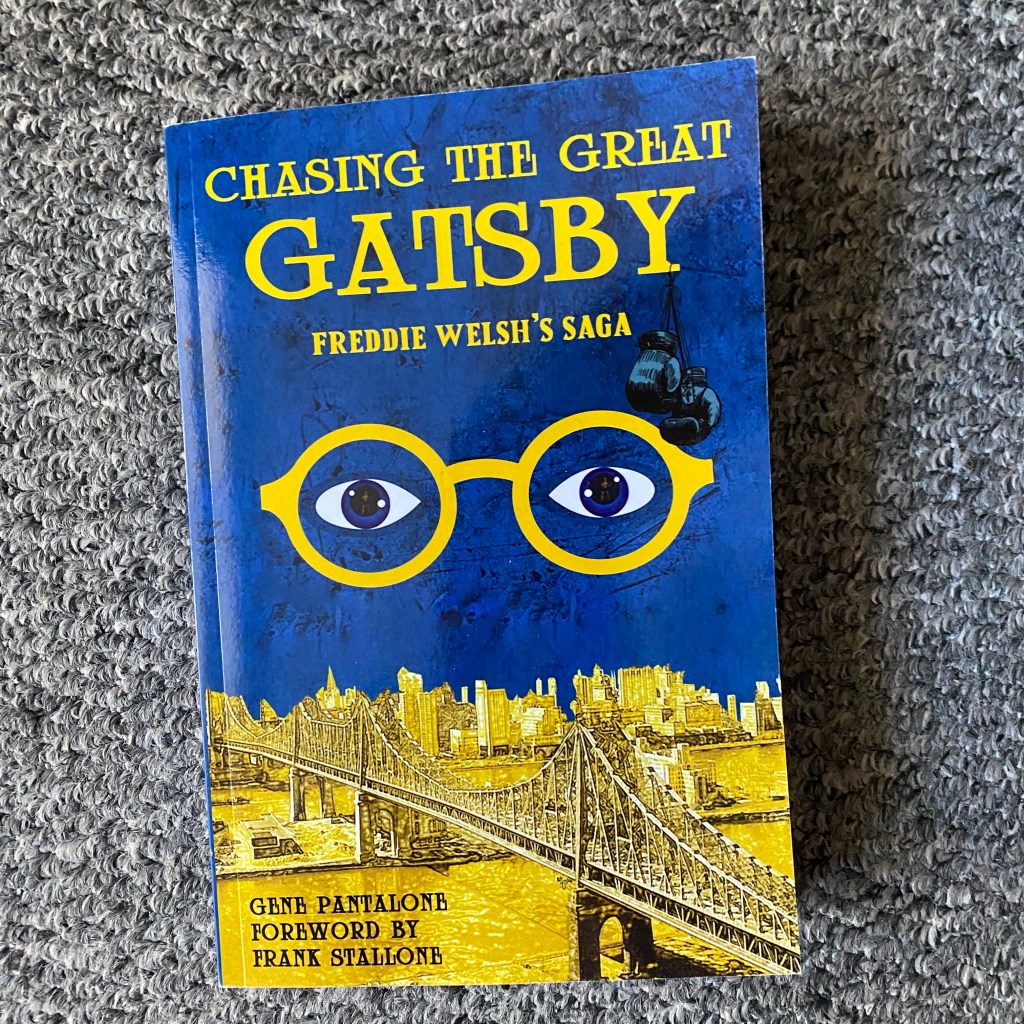
‘Chasing The Great Gatsby’ is essentially a biography of former world lightweight champion Freddie Welsh, by Gene Pantalone. There is, however, a large twist to this book which sets it apart from other boxer biographies: Pantalone’s theory that F. Scott Fitzgerald based the character of Jay Gatsby, protagonist of ‘The Great Gatsby’, on Welsh. This theory alone was intriguing enough to make me order this book; my reading time is heavily restricted due to other commitments and I’ve made a decision to not read any standard biographies until I’ve got more time.
Each chapter of this book opens with a quote taken from Fitzgerald, the majority from ‘The Great Gatsby’, as a framework with which to build the case linking one of Britain’s earliest world champions with one of the best known characters of 20th Century literature. I should say that Pantalone acknowledges in this book that his theory and own research follows on from the work of others, particularly Andrew Gallimore who made the same connection in his own biography of Welsh.
Freddie Welsh, born in Pontypridd in Wales, rose to prominence in the ring after moving to the USA as a young man, before eventually winning the world title in 1914. During his career Welsh was also British as well as European champion at the same weight. He fought at a time when boxing was hugely popular and when it was possible to rise from relative obscurity to high society in America, where sports stars, particularly boxers, were held in much higher regard than in Britain.
It’s easy to imagine how the stereotypical rags-to-riches story which accompanied the majority of boxers appealed in a country obsessed with the idea that any man could work his way from nothing to the highest positions. This reflected Welsh’s own journey and must have appealed to a number of people engaged with documenting American life and society at a time of enormous technological upheaval and change.
However comprehensive the argument for a link between Welsh and Gatsby, I find it difficult to believe that Fitzgerald based such a prominent character on one figure. It’s much more likely (as acknowledged in this book) that Jay Gatsby was a composite of a number of prominent contemporary individuals.
There is an interesting opening in the preface to this book in which the reader is invited to jump forward to chapter eighteen to immediately read the author’s claims for Welsh’s influence on the character. However, after considering possible motivations, I still can’t work out why this decision was made. If Pantalone believed that this chapter was important why didn’t he open with it? It left me with a feeling that he wasn’t completely confident in his attempt to write an off-centre boxing book.
The world of boxing literature is fairly conservative, with most books falling into a few genres: biography, anthologies of journalism/essay, and the heavyweights like McIllvanney, Hauser and McRae taking on a more sociological approach to capture the wider reaches of the sport. I imagine it must be quite hard to publish a book which sits outside these areas, and perhaps it was this concern which led to Pantalone’s approach and aim here feeling a little unclear.
This blog is intended as a space for me to respond to, rather than review, the books which feature. However, I feel like I can’t write about this book without commenting on Pantalone’s prose style: I don’t remember ever reading a sports book, or biography, with such a verbose style and deliberately flowery prose. I found the author’s mode of writing exhausting at times, and it was often a barrier to following his point of view and perspective. I really can’t understand why this decision arose (I’ve not read anything else by Pantalone so can’t say if this is how he usually writes), as the text often stalls in its elaborateness.
 Writers on Boxing
Leave a comment