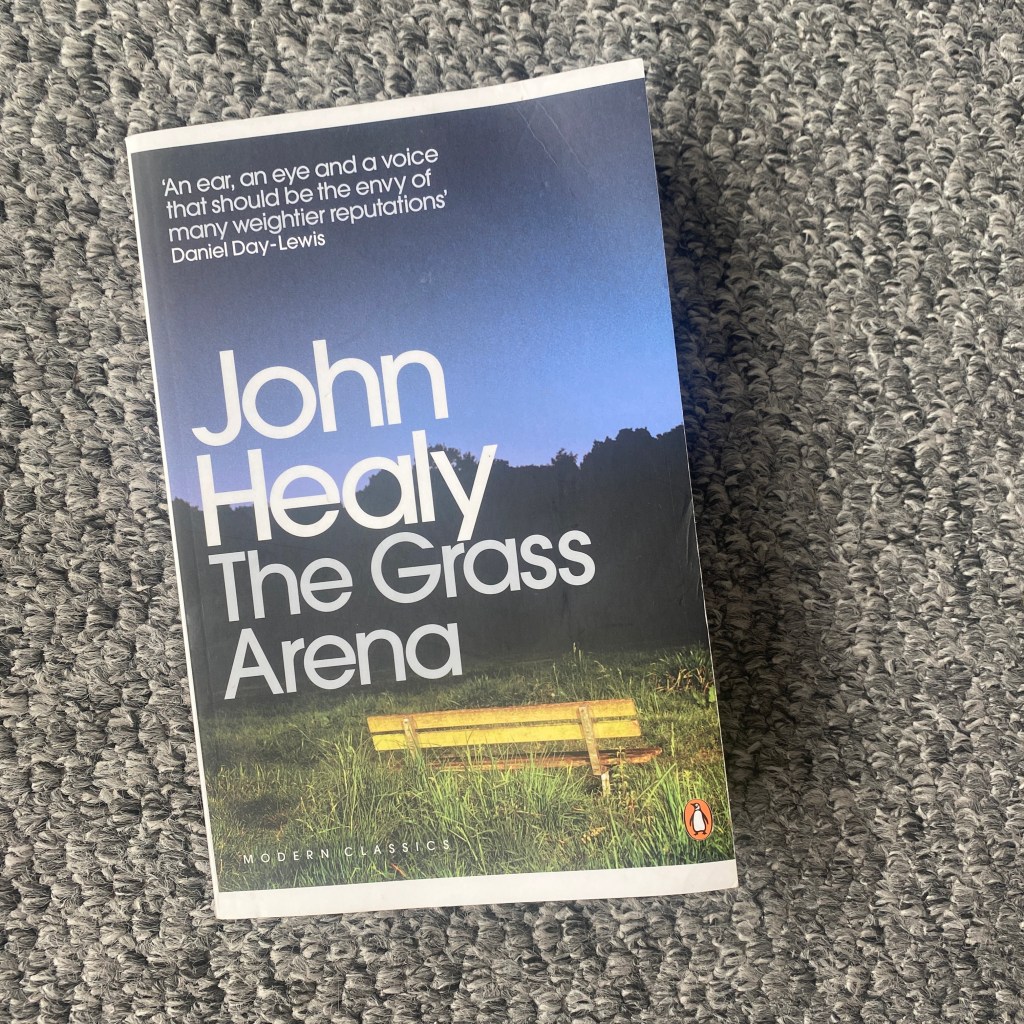
The Grass Arena is the, at times, harrowing autobiography of John Healy, recounting his years living homeless with a severe alcohol addiction.
I have been wanting to read this book for a few years now, after watching the documentary about Healy’s life, Barbaric Genius. I had intended it to be a break from reading solely about boxing as I prepare to begin a creative writing MA in the autumn; the book, of course, features boxing as early as page 19. It haunts me!
Healy was born into an Irish immigrant family in Kentish Town, north London, and he and his siblings suffered from the xenophobia that was very common in 1940s London. After a number of ‘scrapes’ with local kids Healy’s abusive father took him and his brother along to a local boxing gym to learn how to defend themselves. After some initial nerves Healy learned that stepping in the ring to spar was a haven from the abusive family home and streets he was growing up on:
After the first week I loved it, and was always willing to go into the ring to spar with the lads bigger than myself for the experience. It was a joy, just the two of us, no insults about race, no mates to back my opponents up against me. I would get stuck right in, landing punches and taking them in return.
As a young man Healy began training at the Olympic Gym at Warren Street, central London, where he claims to have sparred with a number of top professionals, including British and Commonwealth middleweight champion Terry ‘Paddington Express’ Downes. As addiction to alcohol took over his life Healy was banned from the gym, and he drifted into a life of drinking, crime and vagrancy before eventually finding a form of balance in the British Army.
While serving in the Royal Fusiliers he began boxing for his regiment, though encouraged more by the promise of lighter duties, better food and greater opportunities to drink. He enjoyed some success during this phase, winning some inter-company and battalion competitions, but again the pull of the drink over him was too strong. Eventually, he received a dishonourable discharge which cemented his seeming destiny to live destitute on the streets of London.
The rest of the book is full of horrific tales of drinking, trauma and violence while trying to exist in a society that only ever pretended to care about helping those on the lowest rung of society’s slippery ladder. At every turn a homeless person seemed to be persecuted for merely trying to exist; the methods used at those desperate moments often focused on the use of ever more harmful substances, which inevitably led to chaotic and near-unbelievable results.
Throughout though, Healy maintains an ability to talk of his fellow street-dwellers as, above all, human. Regardless of their plight, the reader is reminded that it is often because of some very minor misfortune that they have ended up in such terrible conditions. Of course, due to the time period, it is almost certain that Healy would have spent time living rough alongside former professional boxers fallen on hard times; there is mention of a former Scottish welterweight champion but only a first name is given (full names were of little importance in this world anyway).
The book, however, does have a positive ending, for Healy at least: he learns to play chess whilst in prison, resulting in him kicking his drinking habit to enable him to concentrate on his chess game. It is clear that he has only replaced one all-consuming habit with another, but at least the board game wasn’t going to lead to organ failure.
 Writers on Boxing
Leave a comment