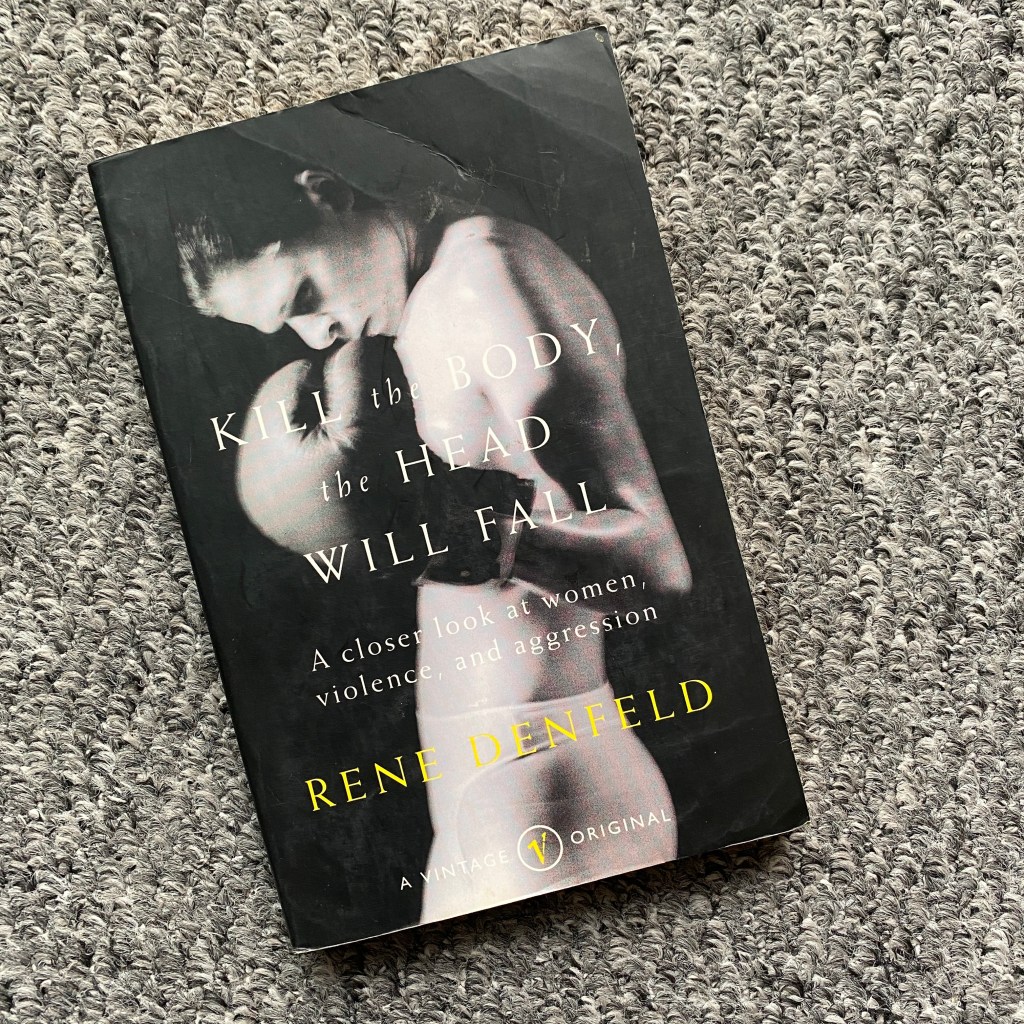
‘Kill The Body, The Head Will Fall: A closer look at women, violence, and aggression’ was written by Rene Denfeld, and published by Vintage in 1997.
What a pleasant surprise this book turned out to be! I completely expected it to be a personal story about the author’s experiences as an amateur boxer (which I would have been more than happy with), but the book is so much more than that. It is, in fact, an exploration of the factors and motivations behind the many reasons that women were denied the right to compete as competitive amateur boxers in the USA for so long (though these factors are as relevant in other countries too).
With each chapter being framed by Denfeld’s experiences of training at the Grand Avenue Boxing Gym in Portland, Oregon, she delves into many areas of academic research that contradict the commonly held beliefs that women are somehow different from men in that they don’t experience aggression and violent urges in the same ways as their male counterparts.
Denfeld looks at how these misconceptions around the body of evidence of the abusive and physically violent behaviour of women, resulting in an outright denial of the existence of such behaviours, had led to women being deemed unsuitable, and ‘too gentle’, for all contact sports, not least boxing.
Whether or not it is a failure to acknowledge that women are just as likely to be abusive parents as men, or as willing (if not always physically capable) in carrying out violent assaults and murders, this has lead to a disinclination by police forces to investigate allegations against, let alone prosecute, women, resulting in crime stats backing up these prejudiced ideas.
These complicated factors, Denfeld suggests, lead to a society which largely believes that women are incapable of the feelings and emotions which, in adolescent men, are seen as the main reason to take up a sport like boxing. She also talks of the many ways in which women, as children and adolescents, are denied those methods and outlets for displaying frustration and anger which are seen as standard and necessary coping mechanisms for young men. Without these coping tools or venting mechanisms, women (or anyone) will only inevitably ‘explode’ from the pressure building, and when they do they are usually viewed as either ‘crazy’ or ‘ridiculous’.
It seems for Denfeld that this ridicule is the most painful act of judgement by society. Being made to feel silly or juvenile for expressing fairly standard human emotions, while at the same time being reminded that these describers are only ever placed onto her gender in these circumstances.
Interestingly, Denfeld writes of her newfound freedom to get into the gym and first take out her daily stresses on the heavy bag, before moving onto sparring with other gym members (mainly men). Due to the proliferation of stereotypical ideas around stress management, she had been under the impression that the physical exertions of the gym would help her to be calmer in everyday life. Denfeld explains that the newfound strength she developed in her upper body, and an overall greater control of her body and physique, left her shocked at how it would sometimes make her feel more inclined to act aggressively, knowing that she was suddenly capable of so much more. I think this reflects my wife’s own experiences but I don’t want to speak for her, so I’ll leave a space for her own comments:
[Lizzy: Ah, I cannot wait to read this book. I agree that the most pain stems from the ridicule of not having your anger taken seriously – every day. It makes your first proper ‘crack’ on the midriff of the heavy bag that much more delicious when it comes. And yes, it has been a revelation to find that finally being granted an outlet for my aggressive impulses (oh I have so many), has not meant that my aggression has lessened. I think this is because I am catching up on all that missed time; though I truly am anti-violence, and do not wish to see anyone hurt, I am just excited to walk along a street packed with people and simply know that I COULD IF I WANTED TO. I’m doing little experiments, testing out ‘not moving out of the way’ on the steps out of the station, and watching as the Big Men actually step aside. I’m not acting like a you-know-what (look at me continuing to justify myself), I’m just making an agreement with myself to start taking up the space that I haven’t been able to until now.]
It’s very interesting to read this book nearly 30 years after its publication. In 1997 in the US, women were only just being granted the opportunity to enter amateur boxing competitions (Denfeld herself was the first winner of the Tacoma Golden Gloves tournament), and of course, in 2024 it seems almost ridiculous that this was such a fiercely fought legal battle for equality.
Lizzy and I were at the Haringey Box Cup this weekend, and it’s always a joy to be at any tournament with so many girls and women either competing or watching. While there must always remain a tinge of frustration about the struggle women like Rene Denfeld had throughout their time in boxing, and life in general, it must be a huge pleasure to see generations of young girls entering the sport without the same experience of denial and judgement based on their gender. To see them swaying, all broad-shouldered and braided-hair, through a large hall full of boxing people, and automatically taking up the same amount of space as the boys. (Except perhaps for the super-heavyweights! But that goes for us all!)
 Writers on Boxing
Leave a comment