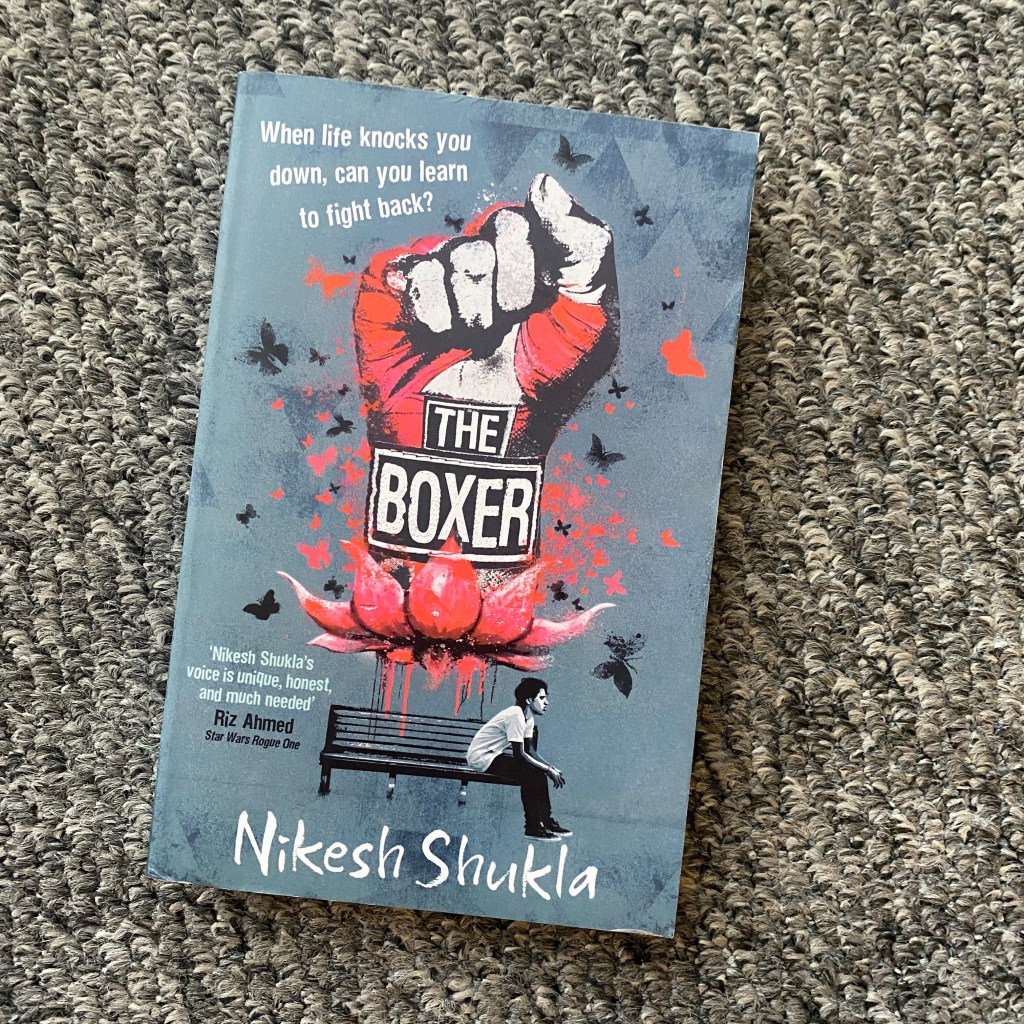
‘The Boxer’ is Nikesh Sukla’s Young Adult-genre novel, published by Hodder Children’s Books in 2019.
The boxer in question is teenager Sunil, the victim of a racist attack in Bristol, who eventually finds himself in a boxing gym in an attempt to learn self-defence. As he begins to train, ‘Sunny’ battles the traumatic effects of the attack and the mark it leaves on his family life, friendships and college life.
Using the analogies often associated with boxing, Sunny goes on a journey of self-rediscovery, learning to claim and take up the space offered to others but perhaps not traditionally to people of a similar heritage and background. Through the feeling of planting his feet when punching, he learns to plant his feet and hold his position in an unjust society, and to carve his own place in the city he has recently moved to.
‘Well, I guess at first I was doing it for self-defence. But now… it’s because it’s helping me take up space.’
‘What do you mean?’
‘I dunno, man,’ I said collapsing on the floor for fifteen seconds of recovery. ‘I spent so long not wanting to take up space, have no one look at me. Now I’m starting to see how becoming a fighter can help me own my space.’
I’ve only really read YA-fiction as result of compiling this blog, and it always amazes me how it affects me emotionally, and I’m often on the verge of tears. The style of writing is commonly very direct, with no attempt made to hide the author’s efforts to pull at your heart strings. That, coupled with the protagonists being teenagers, means any awful situation just seems so much worse.
I don’t ever want to be overly critical on this blog, and particularly when talking about a book aimed at young people and focusing on such serious issues… but… as previously acknowledged, this blog is aimed at keen boxing fans, and we can be a picky bunch when technical aspects of the sport we love are represented in literature. At the start of each of the ten chapters (annoyingly called ’rounds’), a grudge bout between Sunny and his friend Keir is described in sections. Throughout the book, both boys train at an amateur gym and seemingly have no competitive bouts (or they’re at least not described). They jump from this inexperience to a ten round bout, in which both are knocked down several times.
Now, this is a fictional novel, and like Rita Bulwinkel’s ‘Headshot’ doesn’t need to be completely accurate. But it is jarring when, up until the point of any bouts, a lot of research has gone into making the framework of the story very realistic; to then take such a cinematic leap toward what felt like a Rocky-style encounter between the boys, one which would never have taken place, and even if it did it would probably have been stopped due to knockdowns.
Anyway, I ended up being far more critical than I intended to. It is a good book for its target readers, and communicates its message very clearly.
 Writers on Boxing
Leave a comment