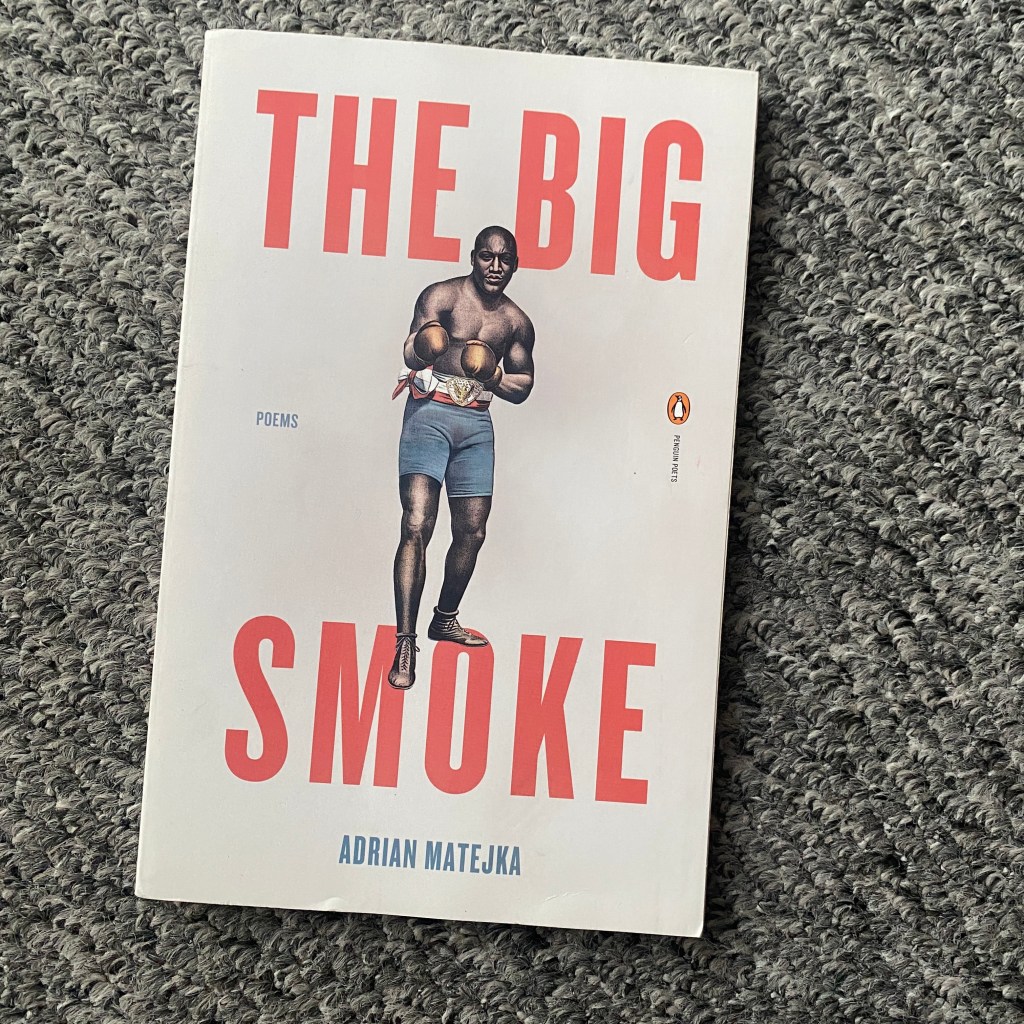
‘The Big Smoke’ is Adrian Matejka’s 2013 collection of poetry which tracks, in lyrical form, the life and career of heavyweight champion ‘Papa’ Jack Johnson.
There was a period of my life in which I was completely entrenched in poetry. Between 2014 and 2020 I did little else than write poetry and interview/record hundreds of poets for my Lunar Poetry Podcasts and A Poem A Week series. After taking my leave of LPP and handing that series over to new producers I took a complete break from all things poetic. In what has been a relatively short space of time I seem to have almost entirely lost any critical poetic language I once held – a very good lesson in the importance of practice in order to maintain skills. At least I’m not a boxer, unpracticed, stiff and in very real danger of being stalked by an ambitious opponent.
I approach this post about a very good collection of poetry from this position of acceptance, that I’m probably no longer very apt to do so.
The main thing that struck me while reading this book was a reminder of the power of imagery in crafted poetry. Through very simple poetic devices the dreams and conflicts of individuals can so quickly be made analogous with those of whole groups of people, and from short phrases and sentences explode vast images encompassing human rights. I’ve made a conscious decision to not pull out individual lines to quote, as they just seem adrift and lacking when inserted between my ramblings. Matejka’s lines deserve better than that. They deserve to remain exactly where he’s obviously so carefully placed them.
There’s repetition throughout this collection, both in the imagery and with several of the poems sharing the same titles. This repetition seems apt for a boxer whose life and training might seem like a never-ending carousel of unremitting actions, but also for a Black man boxing in America at the turn of the 20th Century and facing recurring oppression because of the colour of his skin.
The word ‘shadow’ is prominent and used often in titles, and seems to point to the weight that he carried as an appointed ambassador for his race; the necessity of using one’s own body as a training tool, and also the trail of controversy (real and manufactured) that followed him throughout his career, eventually resulting in him losing his heavyweight title. There is also a link with the repeated use of this word and the poem ‘Alias’, which uncomfortably but necessarily lists the names given to Johnson by the American press; at best slightly outdated and misguided, though mostly outright and terribly racist, riffing constantly on the colour and tone of the man’s skin.
One of my pet-hates watching boxing is the clichéd use of the word ‘stanza’ to describe a single round of boxing. It just seems so inappropriate to use this as a descriptive term – yes it’s a ‘section’, yes it’s a ‘chunk’, but (and I have further thoughts about this which I’m planning to write about), this desperation to elevate the brutal realism of a boxing match to that of ‘art’ will only ever leave boxing failing to reach that level and seemingly lacking. There’s a valid argument that boxing isn’t really a sport as it can’t be ‘played’, but to say it’s art (while it does share certain elements) feels false. Professional wrestling feels like art. Do we feel like boxing is in the same category as professional wrestling?
I also have a profound dislike of boxing books being divided into ’rounds’ rather than just chapters. This always feels like an editor who knows nothing about boxing has suddenly felt like they’ve had the most radical idea for the formatting of the only boxing book they’re likely to publish.
I do, however, think think that poetry is perfectly placed to describe the drama and reach of a boxing match, if done correctly. Though, one of the reasons I walked away from the poetry world was a disillusionment with the way so many poets viewed the art form, as if it somehow possessed the power to change. I just came to see poetry as a vacuum; at times a beautiful, dark, sparking and desperate vacuum, though only ever a void in which poets speak all too often to other poets. Poetry will never reach the heights of capability to convey the range of human emotion that boxing and boxers can.
What poetry can do is reflect very succinctly what boxers do with their bodies, minds and spirits. This is something that Matejka does very well in this collection, in highlighting the singular drive of a man who, against overwhelming obstruction, fought his way to become heavyweight champion of the world, and held onto that title while so many would have him stripped of the honour by any means necessary.
There is also a number of overlaps in this collection with Michael Winkler’s excellent ‘Grimmish’. Two authors attempting to give a historical account of a person who was recorded during their lifetime by a contemptuous and hate-filled media. This battle to extract the man from the myth has ultimately led to two very different stories being told, but with the same shadows of oppression, racism, xenophobia and exploitation hanging over each.
 Writers on Boxing
Leave a comment