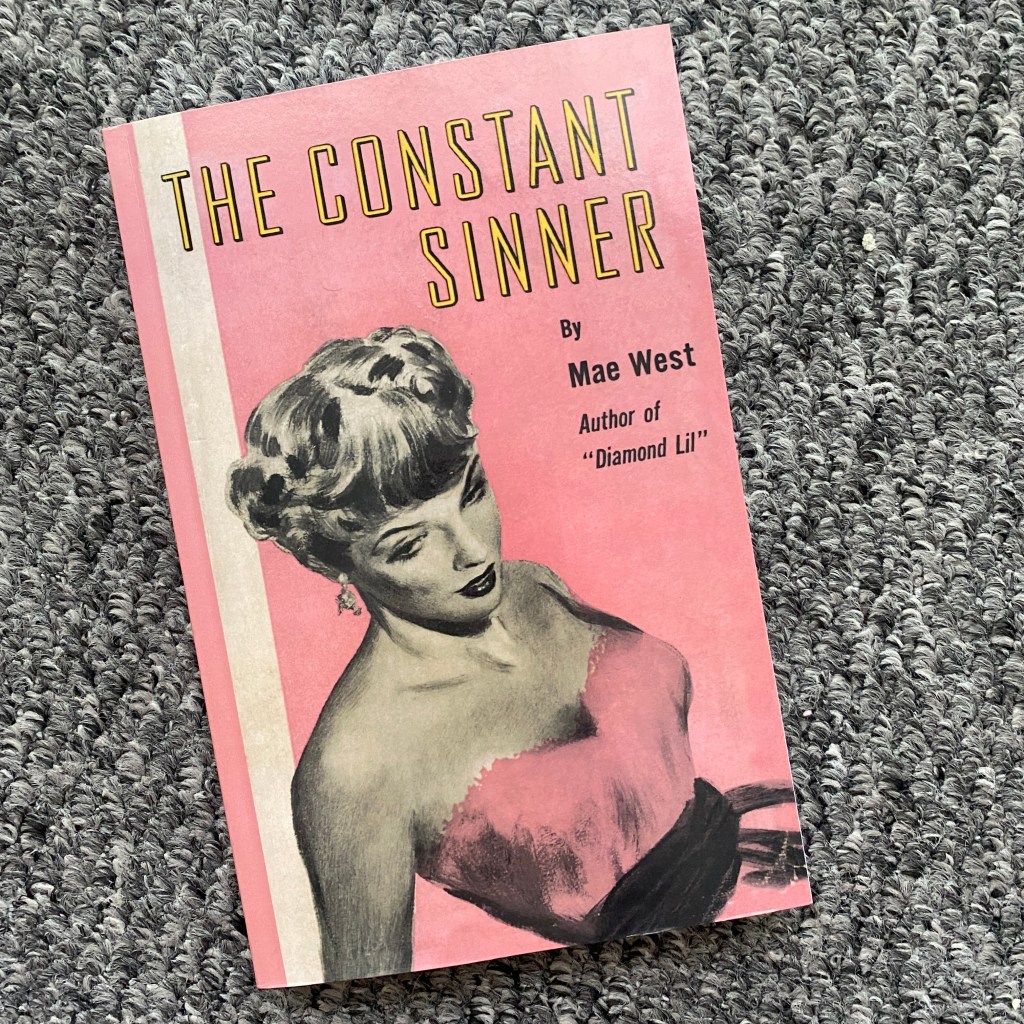
‘The Constant Sinner’, published in 1930, is Mae West’s novel whose protagonist, Babe Gordon, grows up around New York’s 1920s professional boxing circuit.
The novel opens by introducing us to Babe, who is essentially a teenage prostitute being used by boxing promoters to either sabotage the chances of an opponent, by disrupting their training and fight preparation, or to seduce winners of bouts and championships and separate them from as much of the winning purse as possible. She is apparently given to weighing up everyone around her in the same way a boxer might an opponent. Here she is described on the first page:
The Saturday night fight crowd picked its way under the glaring arc lamp in front of of the main entrance like a slow moving black beetle. Babe scanned the humans with an eye to business. Babe was eighteen and a prize-fighter’s tart, picking up her living on their hard-earned winnings. Her acquaintances numbered trollops, murderers, bootleggers and gambling den keepers.
I naively thought that, because this book was written by a woman, that it wouldn’t fall into the traps of so many other novels in the way it describes its female protagonist. Though – and this is just an assumption – West obviously knew the film industry very well, and would have had a very clear idea of what kind of story would sell. That being said, West is very keen throughout the book to sympathetically explain the difficulties of Babe’s childhood, and how these led to the position we find her in. It’s just a shame that we’re reminded so often that the main ‘talents’ which lead to her success are her ability to lie, and her voluptuous breasts.
This difficult childhood, one formed by poverty, is what first links her to the boxers she is surrounded by at the beginning of the book, and it is clear that Babe would have grown up around the people who inhabited the boxing business during the 1920s. The novel is broken roughly into three acts, with the first being the only one which focuses on boxing. Babe meets and seduces a boxer, ‘Bearcat’ Delaney, who is is on the verge of competing for the middleweight championship. Babe’s relationship and eventual marriage to Bearcat drives a wedge between him and his manager Charlie.
Their high living, encouraged by Babe, provides so much of a distraction that Bearcat loses focus, resulting in a lack of training and a missed opportunity to fight for the title he craves. Bearcat and Charlie eventually split, and the boxer takes to driving a taxi. I don’t want to spoil the story for anyone who might want to read this book, but in a (genuine?) attempt to resurrect Bearcat’s career (though also so she can get to looking for another wealthy suitor), Babe helps raise funds to get him up to the Adirondack mountains for a training camp.
The novel takes us next to the eclectic underworld of 1920s Harlem, where Babe looks to reestablish her career and search for suitable targets. I won’t describe much more of the novel as there isn’t really any more boxing content, but I’d also end up giving too much of the plot away, which is genuinely gripping at times. In short, Babe meets two further men who allow her to climb the social ladder before there is a dramatic murder, around which the three men are brought together.
What is most interesting about the book moving away from the boxing arena is that it is only at this point that Babe’s behaviour seems really out of place. Before the novel takes us to Harlem, Babe is just another person making a living from taking advantage of gullible young fighting men. She sits comfortably shoulder-to-shoulder with trainers, managers and promoters, all waiting to skim their share from their fighter’s purse. When Bearcat’s manager Charlie first claims moral outrage that Babe might move in and ruin his fighter’s career, the foundation of this is how he has financially supported the fighter’s development and training. It never seems to register that he only ever supported Bearcat for his own financial gain.
In this respect it seems that Babe has been written differently as a result of the author being a woman. She sits amongst these boxing men as a peer. Using her own wit and guile she carves a valuable and financially rewarding niche for herself, using a set of skills unavailable to the men around her. The jealousy that surrounds her is clearly based in a resentment that she is simply better at skimming earnings than the men watching on helplessly.
I can’t sign off on this post without mentioning how uncomfortable some of the prose and dialogue is in this book. It is at times so racist and xenophobic, that readers would be excused for just not wanting to finish it. Personally, I found the dialogue between black women in Harlem the hardest parts to press on through. It would be easy to just excuse the writing as ‘of its time’, but, particularly when it comes to the women portrayed, it all felt deliberately nasty rather than ill-judged or unenlightened.
This point highlights how West’s racialised language affects what a reader may take away from the prose in general. I wanted to quote what I thought were humorous descriptions of bouts Babe watches on the undercard of the bout in which she first sees The Bearcat fight. Unfortunately, in this circumstance, the ellipses indicate sections removed because of the use of some very uncomfortable language:
[…] Clyde Jackson and Spike McCarthy, heavyweights, knocked into each other like rolling beer casks for four rounds to a draw. Walter Erickson and Oscar Peters, lightweights, hung onto each other like two drunks trying to tell each other a story.
 Writers on Boxing
Leave a comment