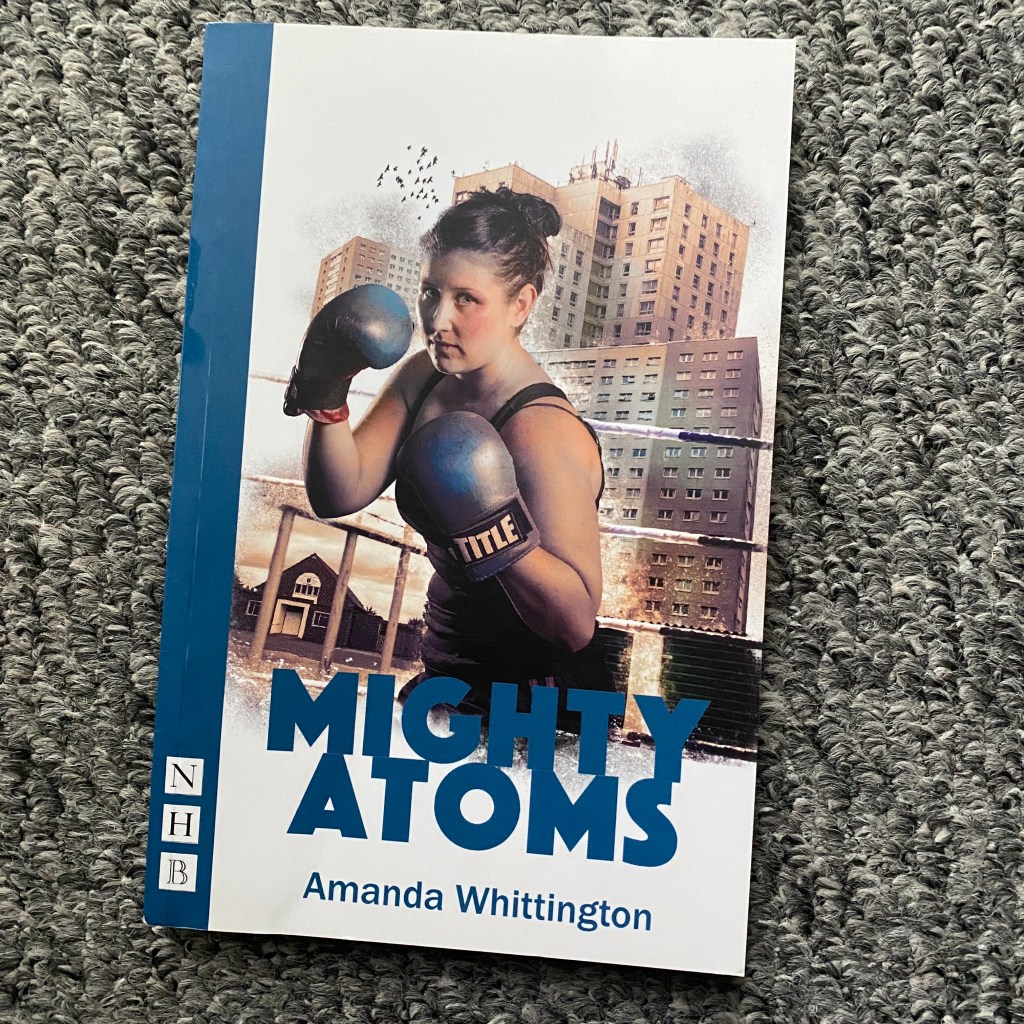
‘Mighty Atoms’, written by Amanda Whittington, is a play which was commissioned by Hull Truck Theatre in 2017, the year in which Hull was named as Britain’s City of Culture.
As with so many plays, I heard about this one only weeks after it was performed near where I live. Annoyingly, the play was staged at LAMDA in London in December 2023. I would have loved to have gone to see it but the script, in the form of this book from Nick Hern Books, will have to suffice until somewhere puts it on again.
As with many boxing-related plays, the boxing is more a framework within which to tell a wider story. The boxing in this instance is community-based boxercise classes held at ‘The Six Bells’ pub in Hull. The classes are given by the reluctant Taylor Flint, who we discover was herself a talented amateur boxer. Throughout the play Taylor is shadowed by the ‘ghost’ of Hull, and British boxing, legend Barbara Buttrick (I say ‘ghost’ due to my lack of knowledge regarding theatrical devices. Let me know if you know!). Buttrick offers Taylor advice and encouragement throughout, taking the form of a feminist and, more importantly, local icon in the form of an apparition.
It was through looking for more information about Buttrick that I came across this play in the first place. It really does highlight the leaps that women’s boxing has made since this play was published, which I assume was written in 2016 or earlier. There is now a number of women who could be held up as inspirational figures for women wanting to box, but this play was written only a few years after the 2012 Olympic Games in London. Whilst there were the outstanding figures of Katie Taylor, Nicola Adams and Natasha Jonas to look to, this doesn’t directly translate into all women and girls having a figure to identify with.
It feels fundamentally important that the women in this play have a local woman to look to for motivation. A woman who had herself ‘escaped’ the surrounding towns, villages and estates and, vitally, the expected gender-based roles which up to that point had defined their lives.
Aside from the boxing, the play deals with class and community issues around what happens when a community hub such as ‘The Six Bells’ is under threat of closure. What can a pub do to provide more than a place to drink? How can it, in fact, prove to people that it always has provided more than a place to drink? Whilst it doesn’t mention it directly, the play feels weighted by the shadow of the 2016 Brexit referendum, and its depressing effect on cities outside the south-east of England.
The women eventually hit on the idea of a charity fight night to raise cash in an attempt to save the pub. Whether they achieve this or not seems irrelevant in the end, as the important point seems to be that they at least feel empowered to do something for themselves, and for the place that is so crucial to their lives.
 Writers on Boxing
Leave a comment