
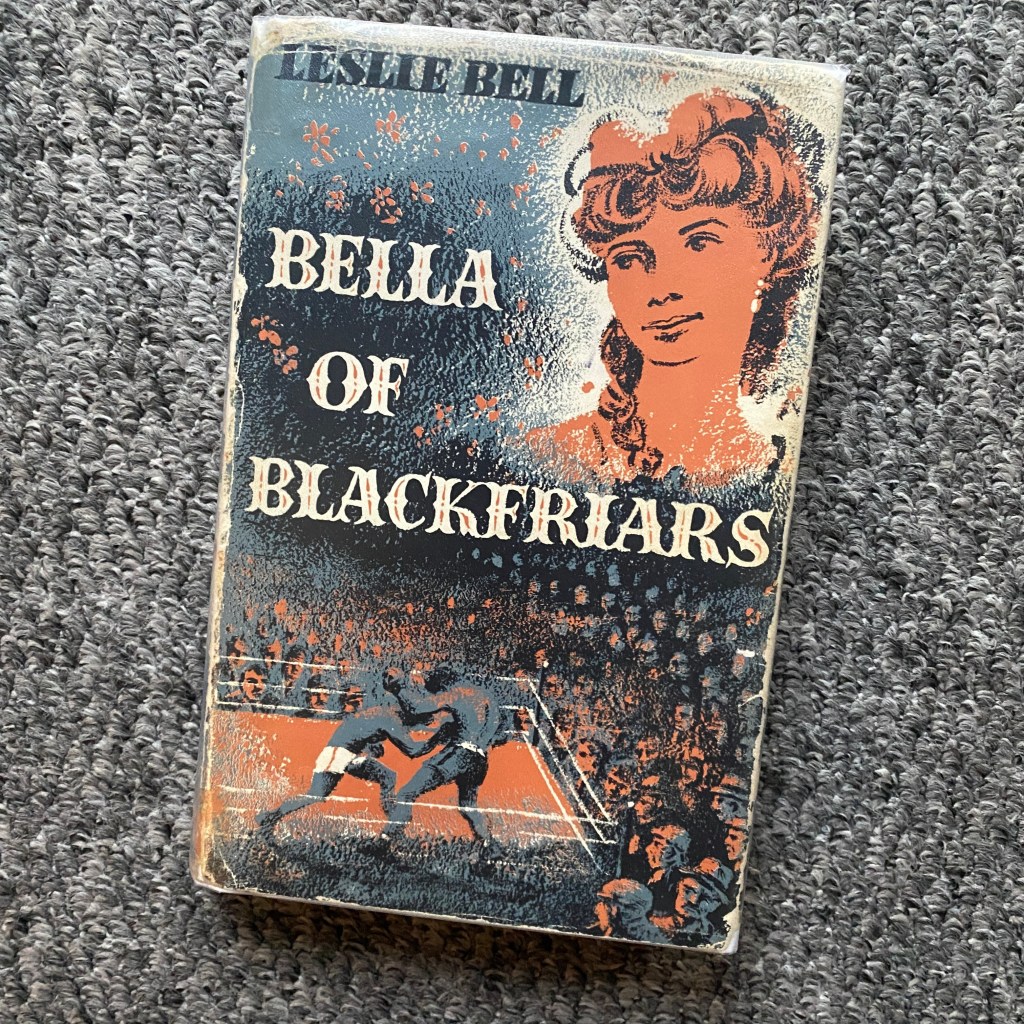
‘Bella of Blackfriars’ is Leslie Bell’s biography of the first woman to work as a boxing promoter in Britain.
Bella Burge was born (Leah Belle Orchard) to British parents in New York in 1877 before moving, with her mother, to Whitechapel, London when she was four years old. By the age of 11 Bella was performing in Music Hall variety shows in London, under the stage name Ella Lane. It was at this time that she met stage superstar Marie Lloyd and the two would go on to develop a lifelong friendship, after Bella spent many years living with and attending to Lloyd.
During this period Bella met champion welterweight boxer Dick Burge, who she would later marry, and with whom she would become intrinsically linked with boxing, as his business partner at The Ring at Blackfriars.
This is probably a good time to mention my one point of contention with this book: the author’s over-reliance on, at times, padding out the book by detailing the lives of both Dick Burge and Marie Lloyd. While the lives of both are vital in the telling of Bella’s life-story and career development, it was sometimes distracting and disappointing that many pages would pass by without any mention of Bella. This is particularly troublesome in the chapter detailing the financial fraud-related court case which Dick became embroiled in, leading to his imprisonment for two years. The chapter goes into great detail regarding the case and at times it’s easy to forget who is actually the subject of the book.
That being said, when the book arrives at the point of the Burges opening their own boxing venue in the old Surrey Chapel building on Blackfriars Road, south London, Bella’s character comes much more to the fore. As does the role she played in supporting, and bank-rolling, her husband’s vision for an accessible and affordable boxing establishment.
I’ve been trying to get hold of this book for many months now, and I’m very grateful to my wife Lizzy for tracking it down and gifting it to me for Christmas. I’m trying wherever possible to read more books focusing on women in boxing, both as boxers and as promoters and managers; but I’m also very interested in the history of that particular area of London as my dad was born very close to the site of The Ring (I better point out that this was decades after the gaff closed down in case he reads this!), and I still have family living at nearby Walworth. I don’t know if I’ll ever have proof of it but I must have relatives who attended as patrons of this ‘colourful’ hall.
I say colourful because the book is littered with references to the reaction of the crowd up in the balcony, or ‘Tatts’, should a decision not go the way of the crowd. From shouting, to fighting amongst themselves, to throwing missiles at the officials:
To referee a contest or give a decision not in keeping with the crowd’s own ideas was to court instant and violent disaster. Down into the ring would shower handfuls of pease pudding and saveloys, hurled with force and accuracy at the hapless official.
And sometimes there was far worse than the crowd’s supper:
As Deyong held up Clarke’s hand as victor, there came over one concerted howl of rage from a section of the crowded balcony, and then the betting boys grabbed the [taxi-cab] driver’s bags and flung everything down on Moss Deyong! Pliers, tyre-levers, spanners – a whole shower of missiles hurtled at the referee, who was losing no time in jumping over the ring ropes and dodging through irate spectators into the office.
It was this (or these) baptism(s) of fire which no doubt gave Bella the confidence to assume full control of The Ring after the death of husband Dick in 1918. Knowing that she couldn’t follow his example of dealing with rowdy patrons by ‘striking first and asking questions second’, she had to develop a new approach when tensions were rising. Luckily for her (and everyone else in the venue), the troublemakers usually responded to a stern talking-to, with the presence of a woman and the threat of a ban from the place being enough to make the men think twice about their actions.
She clearly had a fondness for the regulars at The Ring and was proud of the venue’s tradition of providing a place for the cloth cap-and-muffler brigade, in stark contrast to the National Sporting Club in Covent Garden, with its prohibitively high prices and exclusive clientele. So much so, that when, in 1928, the Prince of Wales was to make the first ever formal Royal visit to a boxing event, Bella refused venue manager Dan Sullivan’s request to hold back tickets and raise entry prices for the evening:
“Not likely! They’ve been supporting us for years and they’re entitled to buy in the ordinary way.”
Before Dick’s death, Bella was already influencing the outlook of boxing promoters when, in the build-up to Georges Carpentier’s clash with ‘Gunboat’ Smith at Kensington’s Olympia in July 1914, she convinced her husband and his co-promoter Frank Morley to target women in their marketing campaign, after ticket sales had proved very disappointing:
“[…] I go to boxing at The Ring, but I’m the only woman who does. What’s more, I’m the only woman who goes to boxing anywhere in this country. All right, that’s mainly business; but I’ll tell you this, Frank, I’d queue up to see this Carpentier – as a woman – not a fight fan. And there’s thousands more of us more than ready.”
Whilst this is a sign of the changing times, this was still a radical step, as British boxing lagged far behind American and even European promotions (Djuna Barnes’ essay ‘My Sisters and I at a New York Prizefight’, written in the same year, is a good place to explore the differences on this subject).
Bella continued to be forward-thinking in her approach to promoting events at The Ring, remaining unafraid to press her opinions onto the men doing the fighting. A perfect example of this was her encouragement of the boxers to embrace the American fashion of wearing a dressing gown to the ring, as opposed to the more traditional heavy towel or overcoat. This was no small task during this period, when anything swaying from the norm was viewed as effeminate or weak, or perhaps worse still, arrogant:
The wearers did not at first get a comfortable reception from the Blackfriars audience accustomed to the old towel, or jacket or overcoat slung over the shoulders, but the idea gradually caught on amongst the top-liners. While this refinement was acceptable by men who were fighting fifteen or twenty rounds, the Ring crowd took a very poor view of similar pretensions by lesser fighters.
One evening a mere six-rounder, fired to emulate the new fashion, had been to some pains to equip himself for his contest. He appeared in the ring wearing a red dressing gown, one borrowed from his sister; in the style of the period it had fancy lace at the top and bottom and was furbished with the usual trimmings. The gallery occupants took one startled, disbelieving scrutiny, then hurled at the ambitious wearer their outraged, pertinent comments from all directions, comments of such a pungent, definitive nature that Bella, her cheeks flaming, had to put hands over her ears and run for the office.
By the mid-1930s audiences had begun to dwindle due to a proliferation of other mid-sized boxing halls, larger purses pulling boxers away from The Ring, and the growth of other sports such as greyhound racing. In an attempt to keep the place going Bella resorted to allowing wrestling to take place, as well as some theatre productions, but eventually the doors closed. With the outbreak of WW2 the lease lapsed on the venue. In 1940 The Ring was struck by a Nazi bomber, which all but destroyed the building.
At the time of the book’s publication Bella was still alive and living in Bloomsbury, central London, and spending her weekends in Banstead, Surrey, at the house of Marie Lloyd’s sisters. Bella Burge died on 3 September, 1962.
The site of The Ring is now a modern office, but on the other side of Blackfriars Road is The Ring pub, which is well worth a visit if you’re in the area, with its walls covered in boxing memorabilia, much of which is related to the old boxing hall.
Some interesting points in the book about the venue and its characters:
- Chapter 18 looks at some of the great characters who boxed at The Ring, such as Desmond Jeans ‘The Monocled Pugilist’, and Jimmy ‘The Ghost with a Hammer in His Hand’ Wilde.
- In August 1925, heavyweight Phil Scott faced three men in one week at the old chapel, fighting Jack Stanley on the 24th, Tom Berry on the 27th and Gipsy Daniels on the 29th, defeating them all.
- And as a nice coincidence, as I was reading this passage 100 years to-the-day later, Danny Frush took on Billy Matthews on New Year’s Eve, 1923. Due to controversy surrounding illegal blows and a brewing riot in the balcony, Bella refused to announce the verdict that evening, with the result being posted outside the venue on New Year’s Day, 1924: Frush as the winner, after Matthews was disqualified for a draw.
 Writers on Boxing
Leave a comment