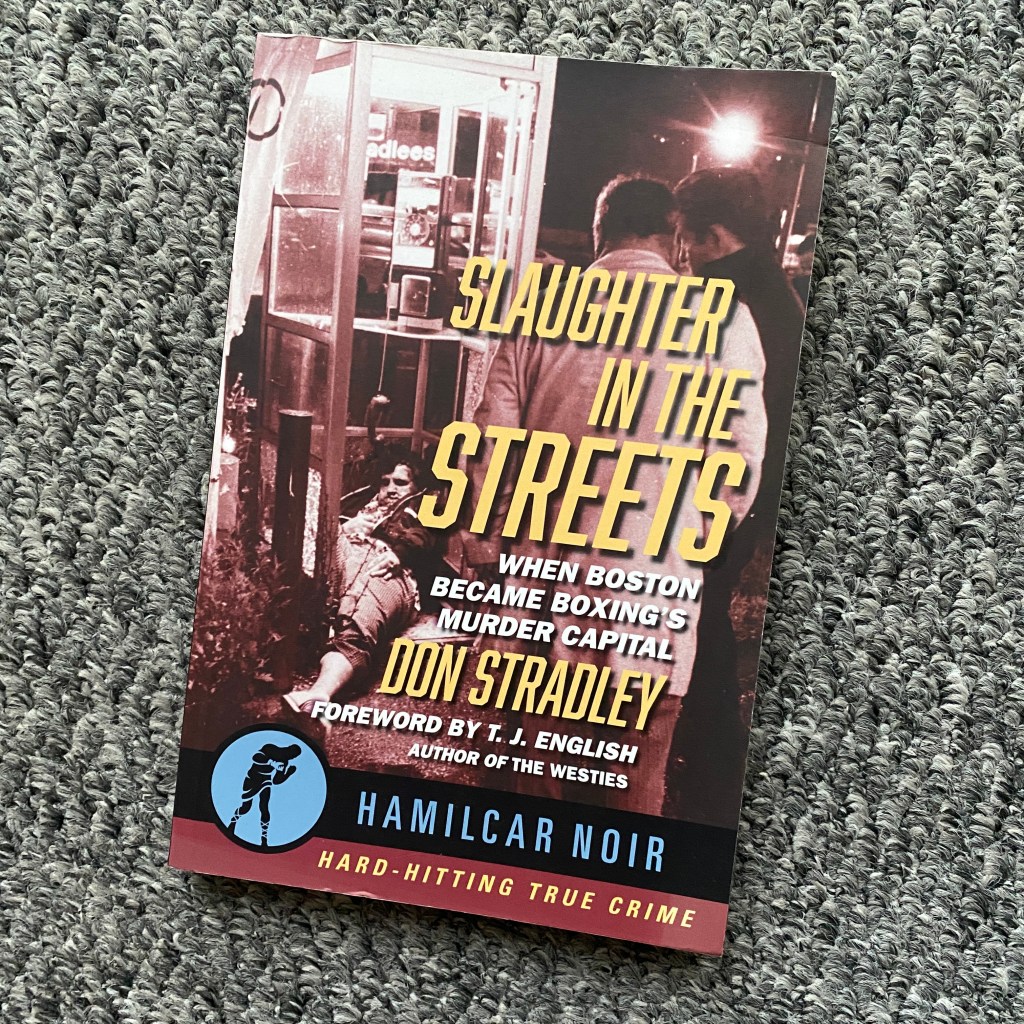
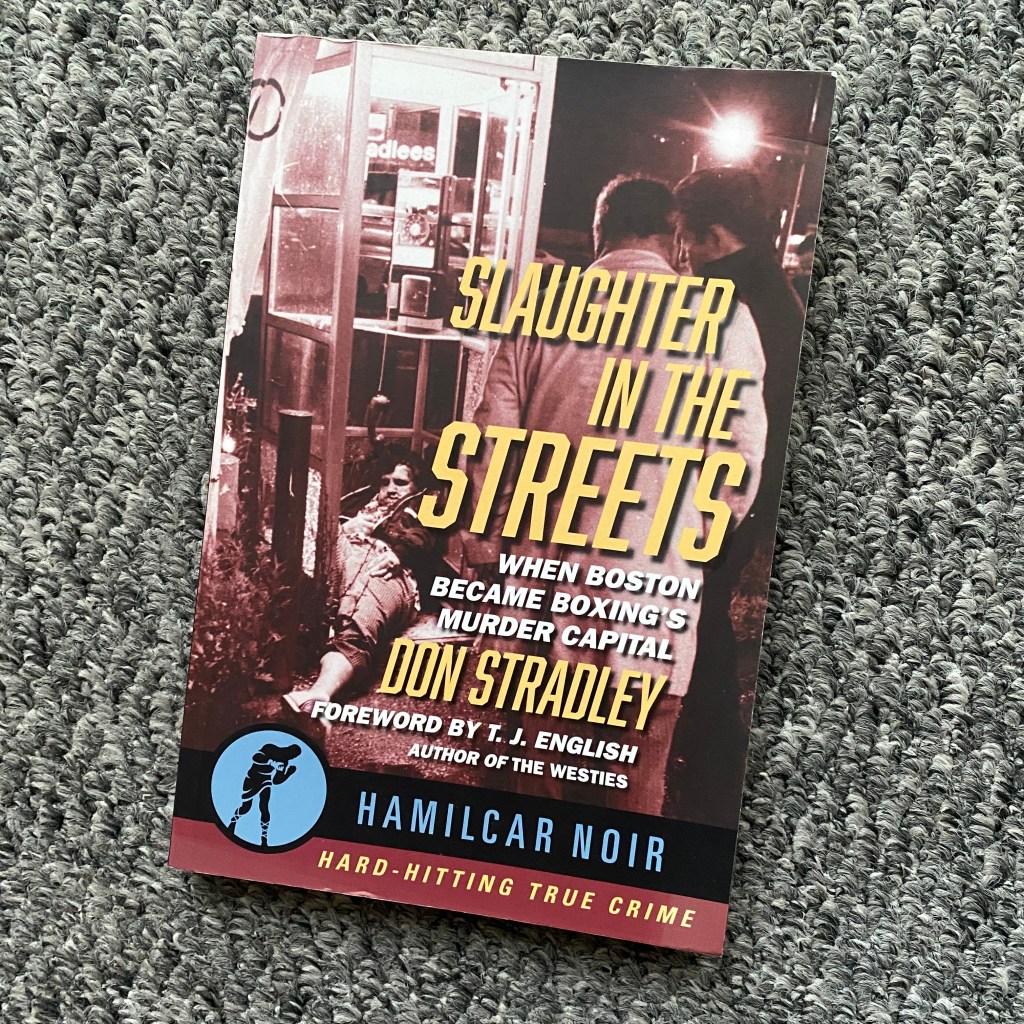
‘Slaughter in the Streets’ is Don Stradley’s whistlestop tour of 20th-Century Boston’s murky links to organised crime, and its often fatal links to boxing. It is published by Hamilcar Noir which is fast becoming one of my favourite publishers.
To paraphrase my old nan: This book is just one bloody thing after another! Beginning with the 1931 murder of Frankie ‘Gustin’ and finishing up with David Stivaletta’s demise in 1999, the book is a litany of very gory and depressingly unnecessary deaths of men with sometimes dubious, mostly unspectacular, professional boxing records.
I’ve always had a fascination with Boston’s (and surrounds) crime history, partly because it always seemed so unfashionable and dour in comparison to New York’s ‘glamourous’ mob associations; though I think it was mainly just hilarious to me, as a teenager, that serious crimes were committed in places sharing names with quaint English towns. Imagine being mown down by a gun-wielding mobster in Dorchester! Crazy.
Obviously Boston’s (New England’s) notoriety grew further when Whitey Bulger turned State’s Witness, and ‘ratted’ out his former business associates. Documentaries, films and books abound. Bulger features prominently towards the end of this book (it traces the city’s history chronologically), as a figure lurking in the corner of boxing gyms, waiting to tempt any big lump working over the heavy bag with the offer of quick cash.
I grew up with a group of friends who, variously, went on to become university graduates, police officers, construction workers, debt collectors for drug dealers, and imprisoned. We grew up in a place and time where any of those outcomes could have become reality for any one of us. The reason I mention this is because a central question in this book is why are boxers drawn to criminals, and vice versa? And it seems that the author’s answer is the same as mine: They’ve just all grown up together and have experienced varying luck. They’re just boys from the same neighbourhood, drinking at the same bars (pubs), and eating at the same diners (caffs).
Also, my group of friends had the same shady characters hanging around (perhaps not of the standing of Whitey Bulger), waiting for a young angry man to give in to temptation and snatch the ready bunce in return for intimidating some poor soul. Unfortunately, more than one of my friends lacked the support network to say no, and disappeared down their own rabbit hole.
I’ve decided to not list any of the gruesome details of the many murders in the book. They’re dealt with far better by Stradley, and there’s a huge difference between him attempting to piece together an important period of social history and me passing on selected lowlights. I think that would just seem a bit ‘gossipy’. But if this crossover of True Crime and boxing appeals, then get a copy of the book for yourself.
The book ends with an excellent quote as to why boxers and criminals may not be able to shake each other:
The wise guy thinks the fighter might have some money. At the same time, the fighter thinks the wise guy has some money. […] Most of the time, neither one had anything.
 Writers on Boxing
Leave a comment