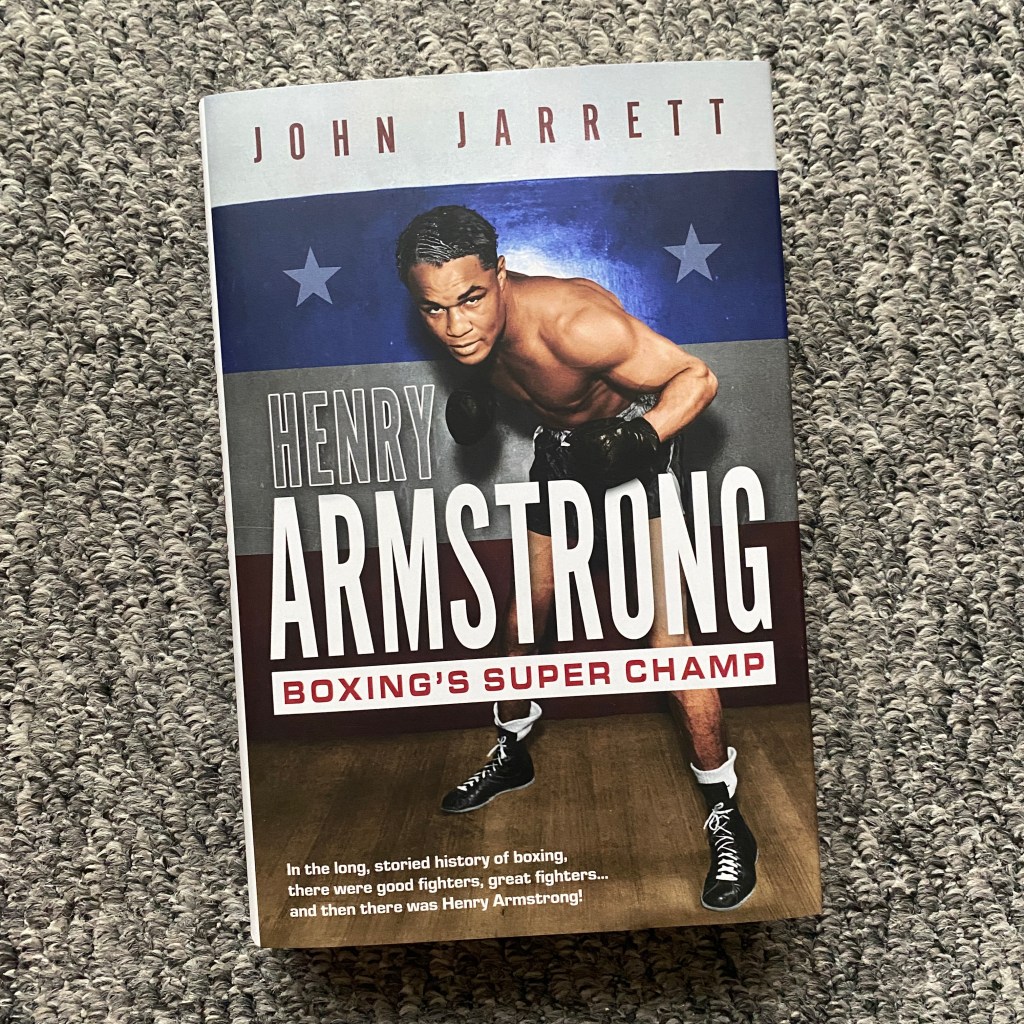
‘Henry Armstrong – Boxing’s Super Champ’ is John Jarrett’s retelling of the career of genuine boxing legend Henry Armstrong, the only boxer to ever simultaneously hold world titles at three different weights. The book is published by Pitch Publishing.
Along with Barbara Buttrick, Benny Leonard and Kid Chocolate, Henry Armstrong is one of the names that has cropped up most often in the reading I’ve done for this blog, and this band of four are probably the names I’ve found it hardest to find any comprehensive writing about. I was very grateful, therefore, when Pitch Publishing got in touch and asked me if I wanted a copy of this book.
As with all books of this nature, this is very clearly the product of an enormous amount of research and editing. It might also be truer to say (and I mean this as a compliment), that Jarrett is less the author of this book and more the compiler, with the text mainly being taken from archival sources of printed material contemporary with Armstrong’s career. There are numerous sections of opinion pieces, lifted from The Ring magazine and a number of LA and New York based newspapers, by writers who have gone down in legend and/or been inducted into the various national and international boxing halls of fame.
I often wish that more authors were as self-effacing as Jarrett has been here, as it’s all too common for writers to place their personality and opinions ahead of the story and subject matter. That being said, it would have been nice to learn more about Jarrett’s relationship, as a fan, to Armstrong/boxing. Perhaps I’ll just have to read more of his books?
Starting to read a book of this kind is always accompanied by level of trepidation, as I’m always waiting for the part where the boxer in question is injured, or is stricken with ill health, or goes bankrupt through poor decisions or fraud, or indeed any combination of these things. Unfortunately, there is a sadness attached to Armstrong’s career early in the book; in 1938 he defeated Lou Ambers’ lightweight title to add to the featherweight and welterweight titles he already held, but according to accounts at the time he was still being booed by large sections of spectators, and there seems to have been an unwillingness to give him the credit he was due (this originally from Harry Ferguson, Ogden Standard Examiner, 1939):
‘[…] what troubled Henry more, perhaps, than [Davey] Day’s [world title opponent 31/03/1939] amazing strong stand, even more than the cut he suffered over his left eye in the eighth round, was the attitude of the audience, which clamoured for Hank’s disqualification every time Armstrong landed a body blow. The fans kept up a continuous booing because the referee, Billy Cavanaugh, refused to warn Henry or penalise him for his alleged infractions of the rules.
We use the word alleged advisedly. For the fans were, in the opinion of this writer, grossly unfair. Of the many of hundreds of punches which Armstrong tossed at Day, this observer (sitting in the second row of the working press) saw only two which landed just below the belt line.’
It always amazes me to see which boxers are able to gain the immediate engagement of the watching public, either by being a hero or a villain, and the inherent drama across a career that can see a boxer leap this polarising divide (in either direction). It seems that Armstrong, though, fell into the cracks between other charismatic fighters, and while not being boring, was possibly deemed a little too mechanic; perhaps even just being too good. It is clear, however, that through sheer doggedness and a willingness to constantly put his body on the line, he won over the majority and became well respected as a great battling fighter of huge heart and courage – known for always being in exciting battles, with the best opponents of his day.
There can’t be any other sports in which the sportsperson’s charisma, or lack of it, is so directionally proportional to their earning power. The nature of the sport seems almost inexcusable, and completely unsustainable, when thought of in those terms; how can we ask young athletes to invent marketable public personas for promotional purposes while they, in very real terms, go into combat and risk their current and long-term health? I just can’t think of any other sport that exists on two such opposing planes of un/reality.
As mentioned, Armstrong was eventually recognised for the enormity of his achievements (perhaps it just took time for people to process the magnitude of what he’d done in such a short space of time), and in chapter 8 there is archive material highlighting how he was being compared to the great boxers who had preceded him. This is an interesting comparison to modern day boxing, in which any current multi-division champion will be weighed up against his record and achievements.
Apart from the often cyclical and rhetorical arguments that this can induce, this is one of the aspects that I like most about boxing discussions. I love how modern day boxers are naturally held up against their forebears, because it highlights how important lineage and legacy are to the context of the sport (the best aspects of AJ Liebling’s The Sweet Science cover this, in my opinion); though not only in terms of the standing of the individual boxers, but to the spectators who, I believe, are attracted to the sport through a wish to be involved in something larger than themselves – to be part of The Fancy, which has no recorded formation date, and which won’t dissipate with the inevitable self-destruction of professional boxing.
The vast majority of us are here because someone we cared for or respected sat down with us and let us share in their joy, either watching a bout or listening to it on the radio. These people are usually a bit older, so most of us are introduced to the sport with tales of fantastic athletes who retired before we would ever have a chance to see them live, appearing human and fallible.
Anyway, without descending into sentimentality, I’ll go on believing Henry Armstrong was one of the greatest to ever do it, because that’s what people I respect have told me; and they were there to see him do it, or were introduced to the sport by people who did. And it doesn’t matter that things started to fall apart a bit towards the end because that’s what happens to all of our heroes who are lucky enough to live a full life.
If you’d like a basic overview of Henry Armstrong’s life, particularly following his eventual departure from boxing, and his collection of poetry, Twenty Years of Poems, Moods and Meditations, then head over to the excellent ‘official website’.
 Writers on Boxing
Leave a comment