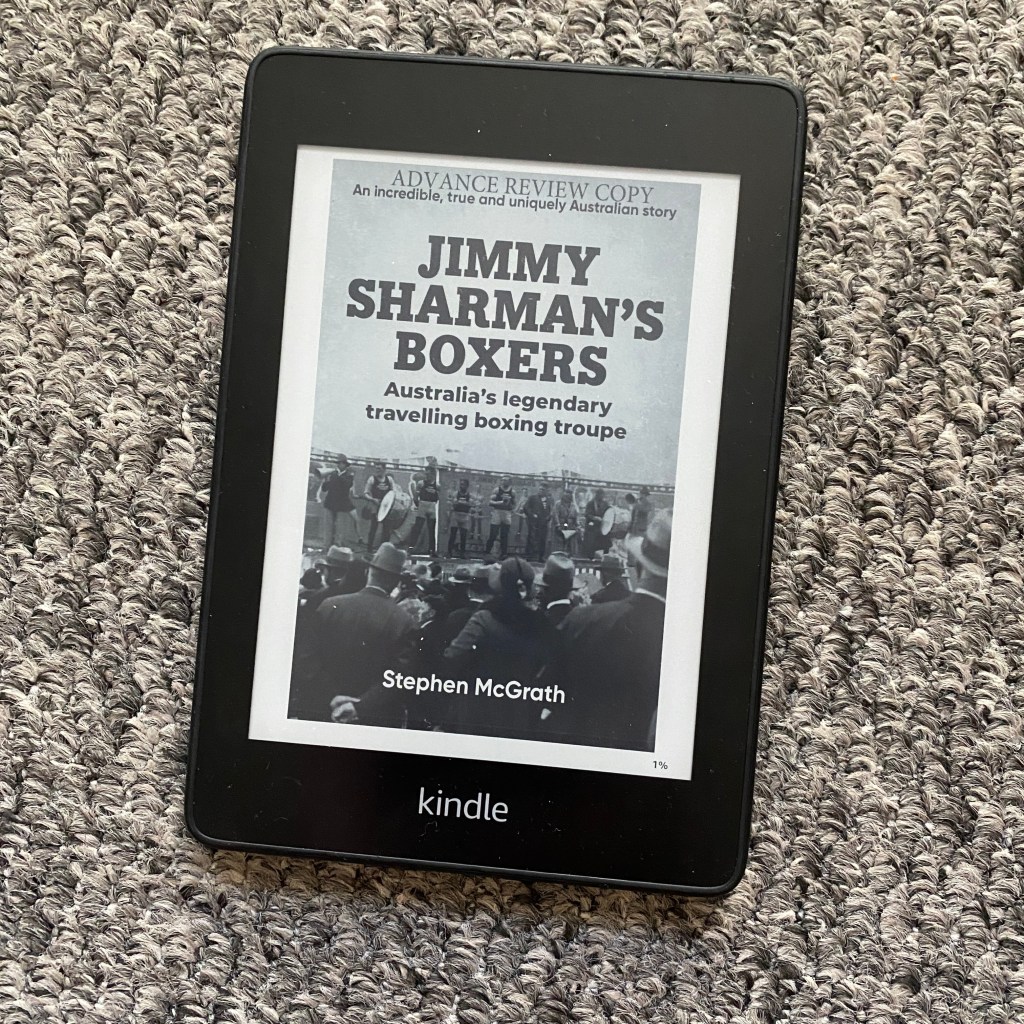
‘Jimmy Sharman’s Boxers’ is the story of Sharman’s legendary Australian travelling boxing troupe, written by Stephen McGrath and published 1 September by Big Sky Publishing.
This book is the culmination of many years’ worth of research by McGrath, and it portrays the lives of many historical characters, while employing some fictional figures, in order to put the events into the context of the time. Most notable among these is Archie Blackmore, who in his role as Jimmy Sharman’s bookkeeper becomes the author’s eyes and ears in his capacity as the book’s narrator.
I’ve been wanting to read more about travelling boxing booths, so it was a happy coincidence when Stephen McGrath got in touch to ask if I would like to take a look at an advance review copy of this book. Having not grown up with internet access it still blows my mind that someone on the other side of the world might contact me to ask if I want to read a book!
I did, however, grow up going to fairs with childhood friends who came from families where everyone was encouraged to throw their fists first and enter into conversation as a last resort. I think our visits to these fairs would have been far less hectic and chaotic if the boxing booths had still been operating, and the more excitable of our group could have worked off their aggression with gloves on.
Anyway, back to Stephen’s book!..
The book joins Sharman’s travelling troupe in 1914, just as the First World War breaks out. The troupe charges around the south east of Australia (unless my geography is completely off), trying to visit as many towns, country shows and fairs as possible, and ultimately make as much money as possible, taking on all comers. The pace of these early movements is dizzying, with Archie Blackmore struggling to keep up at times.
Along the way we learn the tricks of the boxing trade, employed by the booth boxers who, under the tutelage of Sharman, learn how to make fights more of a spectacle. The aim of course is to keep punters coming back for more, and the only participants who go away embarrassed are the town bullies. Through the eyes of the boxers we also learn to ‘read’ a man by the way he carries himself and ultimately fights.
As the book progresses the war looms ever-heavier over the troupe, and the entire country. The years pass, and as war rumbles on, audience numbers dwindle with able-bodied men scattered around the world in defence of an empire most had little connection to.
It’s through the war and the propaganda issued by the Australian government that McGrath tackles the questions of what it is to be a man, who should stand up in times of conflict, and what reason there was for sending so many men around the globe to die in such a senseless war.
The book quickly becomes far less about boxing, and much more about the pitfalls of nationalism and patriotism. Though because of this, it gets to the heart of something important: why do we place so much pressure on the shoulders of boxers to be role models? It often feels that we, as a society, can only excuse the brutal nature of the sport if we kid ourselves that the participants are model citizens. Here, Sharman’s boxers are told by many that they should be leading by example and enlisting, that men will follow them into battle and toward a sure victory. Of course, the only sure thing was the death of unimaginable numbers of young men, fooled into thinking they were acting nobly by fighting for a European ruling class out of touch with their actions.
The book is naturally full of ‘boxing-as-metaphor-for-war’, though as discussed in previous posts, the codification of a number of sports in the late-Victorian period bloomed at the heart of the British Empire, itself obsessed with military strategy; so it’s no wonder that these links can be made. McGrath uses these analogies well to highlight the growing pressure and weighted language used by recruitment sergeants in trying to enforce conscription on the members of the troupe.
In general this is a fairly familiar story of boxers carrying too heavy a burden of expectation, pressured to somehow transcend their ‘savage’ sport while allowing audiences to live vicariously through their actions. Put into this context and against this backdrop, Stephen McGrath has found an innovative way of reexamining this point.
A few other points of interest from the book:
- ‘White Feather Girls’ – I hadn’t realised how widespread and organised this practice was. This must have been hard for a lot of young men to ignore.
- Lists of names of carnival side show acts. As with the names of former sports teams I could read these lists endlessly.
- Always great to see the work of trade unions highlighted in books of this nature. In particular here, the Industrial Workers of the World fighting to protect working class people from being forced to fight.
 Writers on Boxing
Leave a comment