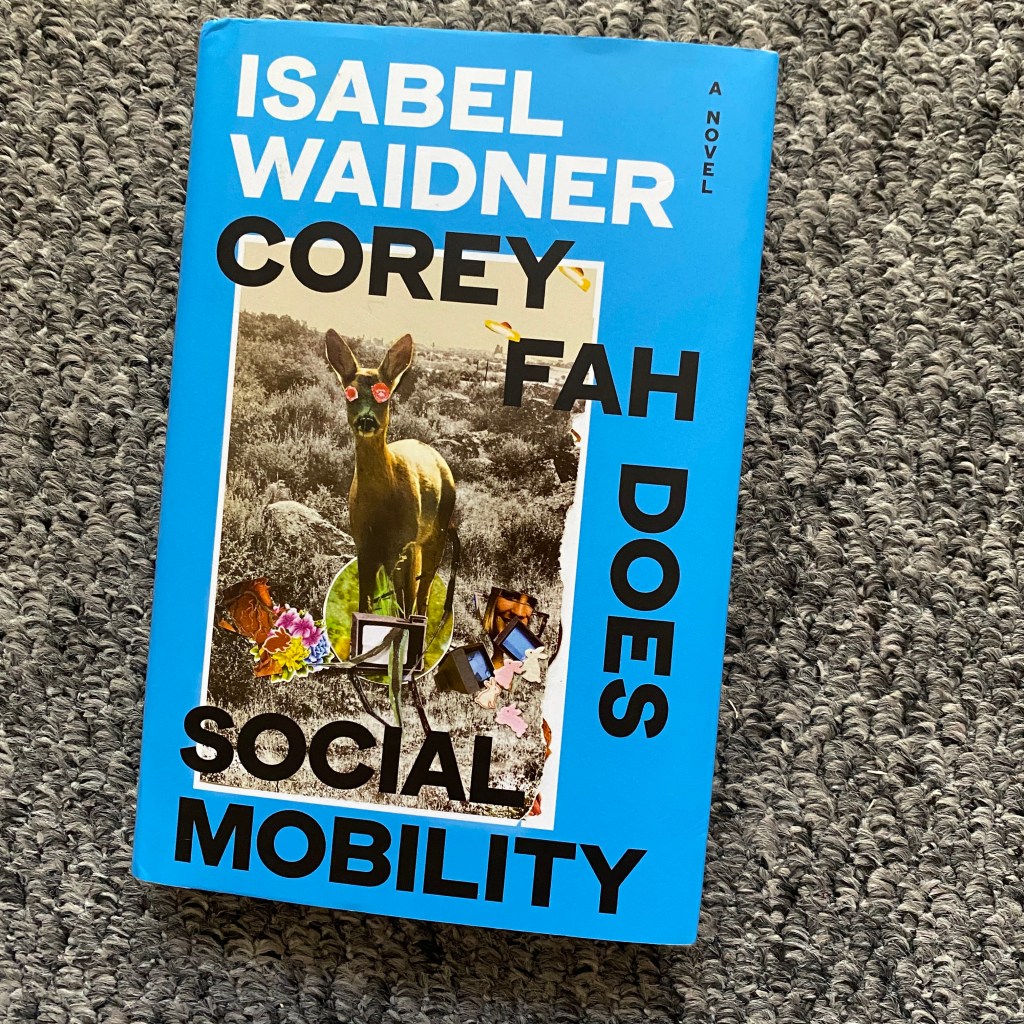
‘Corey Fah Does Social Mobility’ is Isabel Waidner’s fourth novel, and is published by Hamilton Hamish.
It’s a bank holiday weekend here in the UK and as a work-free-three-day-treat I thought I’d put down the boxing books (for the first time in two years) and indulge in my previous obsession: Experimental fiction. I’ve been following Isabel’s career since I saw them read from a printout at a night of experimental writing at the South London Gallery back in 2014(?) and I’ve been excited to get hold of this latest publication, and to give myself a break from this blog and its required reading.
Well, who’d have guessed it, but one of the characters appears, several times, wearing various items of boxing apparel; shorts, robe, points to his gloves. Now, this on the surface in no way qualifies as a book about boxing, even in a minor way, but descriptions of the characters’ clothing throughout Isabel’s novels always seem to carry great significance, acting as social-signifiers for working class protagonists.
The character in question, Sean St Ortan (btw Isabel’s books are always full of the best names you’ll come across in fiction), is gay and working class and I think the significance of their connection to boxing is important to the themes of this blog in general (see also post #15), in that it hints at preexisting ideas of masculinity and violence, and who has the right to explore these ideas in public. Of course, Joyce Carol Oates talks explicitly about the gender-bending aspects of boxing apparel, most prominently the lingerie-like satin robes and shorts of fighters.
Perhaps more relevant to this book is the history of LGBTQ+ folk being encouraged to take up boxing and other combats sports as forms of self-defence, in the vacuum left by governments and police forces not sufficiently tackling the issue of the violence these communities have historically suffered at the hands of bigots. (See ‘A Man’s World’ by Donald McRae) It’s also easy to see why boxing, both visually and physically, would be attractive to gender non-conforming people as it inherently questions and bends those traditional Western roles, by blurring the lines between violence and intimacy.

As with the rest of Isabel’s novels, this latest offering introduces parallel and alternate universes to highlight the multiplicity of ways that people would ideally live and identify, and equally the myriad ways in which they are often denied. But crucially here, and as with boxing (or rather, the clichéd idea of boy-from-the-wrong-side-of-the-tracks-does-good), this novel seems to ask how those who are striving and fighting for a better and fairer society be content (and safe) before the necessary work has been done. How can we be happy here and now?
There are also brilliantly-explored ideas about what it means to be an outsider in the arts. A prizewinner who doesn’t know the language of the established literary world and isn’t really allowed to learn; a prizewinner who knows their moment in the spotlight will only last as long as it takes to nominate and announce the next winner.
I don’t think I’ll ever be able to explain how much I love Isabel’s writing, but over the last seven years they’ve been one of the resounding reasons I’ve tried to be better and to take more chances. This is mainly due to the community they’ve encouraged, supported and protected, allowing us to know we’re not on our own out here.

 Writers on Boxing
Leave a comment