
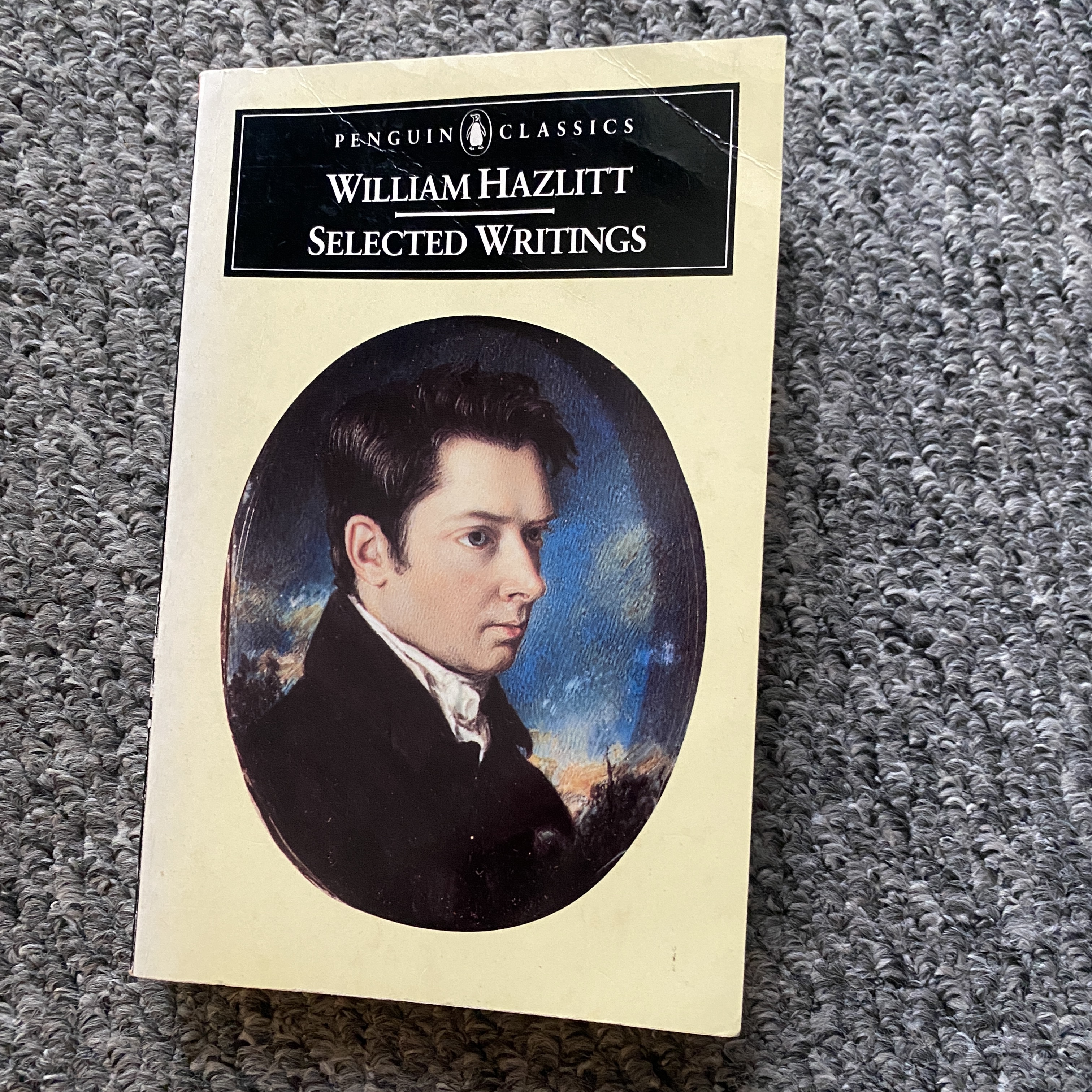
‘The Fight’ by William Hazlitt is, alongside the writing of Egan Pierce, one of the most quoted and cited boxing essays, informing boxing writers for over two hundred years.
This essay is, as a young lad working on the building site I’m currently on says, a stone cold classic! I don’t know how many times I’ve read references to the essay while working my way through the material documented on this blog. For context, I’m going to include a quote from the ‘notes’ section of the book, added by its editor Ronald Blythe:
This splendid piece of sporting writing was nearly turned down by the New Monthly Magazine because it was thought vulgar. It describes the battle between Bill Neate and Tom Hickman (the ‘Gas-man’) which took place at Hungerford on 11 December 1821. It is also a roll-call of Georgian boxers – James Belcher, Cribb, John Gully, Gentleman Jackson, Scroggins, Turner, etc.
The essay begins with Hazlitt making his way along Chancery Lane in Georgian London, to enquire as to the location of the fight between Neate and Hickman. The clandestine nature of these enquiries is immediately apparent, heightened by the fact that this is to be the first fight which Hazlitt has attended. His nervousness about approaching the types of establishments (pubs) where this information can be found is clear from the outset.
The author is approached by a friend and after some discussion he decides to make his way west out of London, first by foot and then by hitching a ride on the mail stagecoaches heading toward Bristol and Bath. As someone that has family in that part of the UK and travels west regularly from London, I can say that this journey has become much less convoluted!
On his way, first to Newbury by coach and then nine miles by foot to Hungerford, on the morning of the fight the author meets fellow members of The Fancy, spending most of their time speculating on the outcome of the fight and basically gossiping about fighters, trainers and other boxing fans. Nothing ever really changes, eh?
One thing that becomes very clear from his writing style is Hazlitt’s love of his own voice. He’s the kind of writer who goes into incredible detail to describe his surroundings and the people he has met, without realising that all he is actually doing is cataloguing his own opinions and how the world is relating to his presence. The idea of writing essays, particularly about art and sport, has always appealed to me, but I think this style of writing has previously put me off as I just can’t ever imagine rambling on in this fashion. How do you ever reach the required word count when you want to get to the point?
The essay includes a great early example of trash talking as Hickman encounters Neate weeks before the fight:
What are you Bill Neate? I’ll knock more blood out of that great carcass of thine, this day fortnight, than you ever knock’d out of a bullock’s!
Hazlitt and The Fancy gather at the site of the fight and continue their gossiping. In addition to the chattering is something that will be familiar to fight-going fans of any era; pre-fight nerves, heightened by anticipation as the fighters gather in the ring and begin strutting about, trying to intimidate and impress:
This is the trying time. It is then the heart sickens, as you think what the champions are about, and how short a time will determine their fate.
Then the fight begins:
After the first blow is struck, there is no opportunity for nervous apprehensions; you are swallowed up in the immediate interest of the scene
At this point Hazlitt’s writing becomes far more succinct and focused, as he attempts, and succeeds, to capture the energy and relentless nature of the action. This is perhaps a little suspect, considering it was the first fight he had ever attended. I’ve tried to compile fight reports previously and I often have trouble merely remembering which round the bout is up to, never mind watching and making coherent notes.
After the fight, Hazlitt returns to his usual verbosity as he and the crowd make their way to their lodging for the night. Along the way he meets ‘loudmouths’ calling in the fix, which had me in mind of the pubs around York Hall.
All in all, it can’t be questioned how important a historical document this essay is, both in covering Georgian bare-knuckle fighting, but also in how information was passed around the UK and how crowds moved around the country during the early 1800s.
 Writers on Boxing
Leave a comment