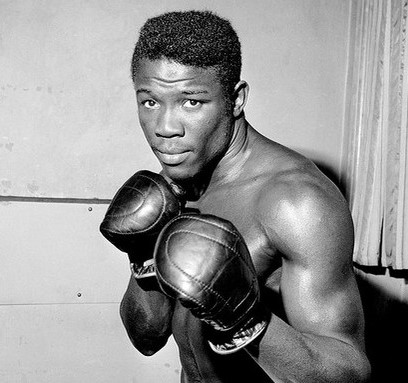
‘Champion’ is an opera composed by jazz musician Terence Blanchard, with libretti by Michael Cristofer, based on the life and career of Emile Griffith. It debuted at the Metropolitan Opera in May 2023.
This is the first opera that I’ve sat through entirely and I’ll be honest, if it wasn’t based on one of my favourite boxers, I wouldn’t have bothered. I have a bit of an aversion to the voices of sopranos, and my my general feeling toward opera is summed up well by the Jamie MacDonald character in In The Loop:
It’s all just vowels. Subsidised, foreign f**king vowels!
The Met have a streaming season each year (apparently), which meant that my wife and I were able to watch the performance at a local cinema in east London. I’m very glad we made the effort to go along, and I was surprised to find myself really wishing that we’d had the opportunity to get over to New York to see the opera live.
As I’ve already mentioned, I don’t have any previous opera-going or -watching experience to base a judgement on, but I have done a significant enough amount of reading about Emile Griffith to say that I felt like his life story was handled empathetically, tactfully and interestingly. The opera was originally commissioned as part of the Met‘s attempts to diversify its programming, and bring in new audiences who usually feel that opera isn’t for them.
The life story of Griffith is tailor-made for attempts at more inclusionary art, it beginning with him being an immigrant arriving to the USA from the US Virgin Islands, a black athlete during the 1950s, 60s and 70s, and on top of all that, he was gay or bisexual (depending on who is telling his story), with a limited number of US states only beginning to legalise homosexuality from 1961.
I say gay or bisexual as I feel like simply saying ‘Griffith was gay’ is to erase the important role his wife played in his life; it seems from some sources that there was a genuine love there, and that it wasn’t just a sham relationship to keep the media away from the story.
As with feature-length films, there is never going to be enough space in an opera to truly reflect the depth of a life like Griffith’s, so at times it will inevitably feel like some elements are pushed together and some are ignored completely, but the production flowed so well that it felt as though all of these choices were very well considered.
One aspect I felt worked very well was how Griffith’s descent into dementia was represented by a refrain (there’s probably an opera term I don’t know here), repeated throughout the opera, to constantly pull the audience back to the ‘reality’ of the elder Griffith character and his bleak, small New York flat. This flat is the starting point for Griffith to journey to meet Benny Paret Jr, to ask for forgiveness over the unfortunate death of his father after his bout with Griffith in 1962, and we’re constantly tugged back toward what haunted Griffith perhaps more than anything.
This device worked really well, and provided a good contrast to the brilliantly lively and colourful scenes depicting his younger years in the U.S. and U.S. Virgin Islands. Also, I think the choreographers dealt very well with the sticky issue of representing boxing action – something that is rarely successful on stage or in film.
Emile Griffith summed up his life better than any writer could, with a quote that is a gift to anyone trying to retell his story:
I kill a man and most people forgive me. However, I love a man and many say this makes me an evil person.
‘Champion’ should be available to stream soon via the Metropolitan Opera’s website.
 Writers on Boxing
Leave a comment